By JILL LAWLESS
LONDON (AP) — A week ago, Charlie Hebdo was a niche publication little
known outside France, with a circulation of 60,000. On Wednesday the
satirical newspaper's first issue since last week's deadly attack on its
staff went on sale with an initial print run of 3 million copies and
front-page coverage around the world.
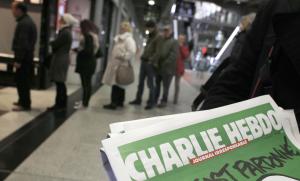
Readers in France mobbed newsstands to buy a copy and European
newspapers reprinted Charlie Hebdo's cartoons as a gesture of
solidarity. But the decision to depict the Prophet Muhammad on the
cover, holding a sign saying "Je suis Charlie" (I am Charlie), angered
many Muslims, who called it a renewed insult to their religion.
By JILL LAWLESS
LONDON (AP) — A week ago, Charlie Hebdo was a niche publication little
known outside France, with a circulation of 60,000. On Wednesday the
satirical newspaper's first issue since last week's deadly attack on its
staff went on sale with an initial print run of 3 million copies and
front-page coverage around the world.
Readers in France mobbed newsstands to buy a copy and European
newspapers reprinted Charlie Hebdo's cartoons as a gesture of
solidarity. But the decision to depict the Prophet Muhammad on the
cover, holding a sign saying "Je suis Charlie" (I am Charlie), angered
many Muslims, who called it a renewed insult to their religion.
Readers in France mobbed
newsstands to buy a copy and European newspapers reprinted Charlie
Hebdo's cartoons as a gesture of solidarity. But the decision to depict
the Prophet Muhammad on the cover, holding a sign saying "Je suis
Charlie" (I am Charlie), angered many Muslims, who called it a renewed
insult to their religion.
MUSLIM ANGER
Many
Muslims believe their faith forbids depictions of the prophet, and
reacted with dismay — and occasionally anger — to the latest cover
image. Some felt their expressions of solidarity with Charlie Hebdo
after last week's attack had been rebuffed, while others feared the
cartoon would trigger yet more violence.
 "You're
putting the lives of others at risk when you're taunting bloodthirsty
and mad terrorists," said Hamad Alfarhan, a 29-year old Kuwaiti doctor.
"You're
putting the lives of others at risk when you're taunting bloodthirsty
and mad terrorists," said Hamad Alfarhan, a 29-year old Kuwaiti doctor.
"I hope this doesn't trigger more attacks. The world is already mourning the losses of many lives under the name of religion."
Abbas
Shumann, deputy to the Grand Sheik of Cairo's influential Al-Azhar
mosque, said the new image was "a blatant challenge to the feelings of
Muslims who had sympathized with this newspaper."
But he told The
Associated Press that Muslims should ignore the cover and respond by
"showing tolerance, forgiveness and shedding light on the story of the
prophet." An angry reaction, he said, "will not solve the problem but
will instead add to the tension and the offense to Islam."
In
Lebanon, the Shiite Muslim militant group Hezbollah said the depiction
was "a provocation of the feelings of more than 1.5 billion Muslims in
the world ... and directly contributes to supporting terrorism,
fanaticism and extremists."
 In
Jordan, the Muslim Brotherhood said it would stage a protest after
Friday prayers in Amman in response to the paper's Muhammad cartoon.
Spokesman Murad Adaileh said the brotherhood strongly condemned both the
killings and the "offensive" against the prophet.
In
Jordan, the Muslim Brotherhood said it would stage a protest after
Friday prayers in Amman in response to the paper's Muhammad cartoon.
Spokesman Murad Adaileh said the brotherhood strongly condemned both the
killings and the "offensive" against the prophet.
That was a widely expressed sentiment. Ghassan Nhouli, a grocer
in the Lebanese port city of Sidon, said the magazine and the killers
"are both wrong."
"It is not permitted to kill and also it is not permitted to humiliate a billion Muslims," he said.
The
Iranian government has strongly condemned the killings, but Foreign
Minister Mohammed Javad Zarif said that in a world of widely differing
cultures, "sanctities need to be respected."
"I think we would
have a much safer, much more prudent world if we were to engage in
serious dialogue, serious debate about our differences and then what we
will find out that what binds us together is far greater than what
divides us," he said.
 Egyptian cartoonist Makhlouf appealed for
peace with his own spin on the Charlie Hebdo cover, replacing Muhammad
with an ordinary Middle Eastern man carrying a placard reading "I am an
artist" in French.
"I am for art and against killing," he added in Arabic. "May
God forgive everyone." The image was widely circulated on social
media.
TURKISH TENSION
Turkey was rare among
Muslim-majority nations to have publications running Charlie Hebdo
images. But the decision has raised tensions in the officially secular
country.
Egyptian cartoonist Makhlouf appealed for
peace with his own spin on the Charlie Hebdo cover, replacing Muhammad
with an ordinary Middle Eastern man carrying a placard reading "I am an
artist" in French.
"I am for art and against killing," he added in Arabic. "May
God forgive everyone." The image was widely circulated on social
media.
TURKISH TENSION
Turkey was rare among
Muslim-majority nations to have publications running Charlie Hebdo
images. But the decision has raised tensions in the officially secular
country.
 A Turkish ordered a ban on access to websites showing
Charlie Hebdo's Muhammad cover, and police stopped trucks leaving the
printing plant of newspaper Cumhuriyet after it said it would reprint
some of the cartoons Wednesday. The vehicles were allowed to distribute
the paper once officials had determined that the image of the Prophet
Muhammad was not shown.
The paper printed a four-page selection of
cartoons and articles — including caricatures of Pope Francis and
French President Francois Hollande — but left out cartoons likely to
offend Muslims. However, two Cumhuriyet columnists used small,
black-and-white images of the new Charlie Hebdo cover as their column
headers.
A small group of pro-Islamic students staged a protest outside
the paper's office in Ankara, the state-run Anadolu Agency reported, and
police intensified security outside Cumhuriyet's headquarter and
printing center.
NO LUCK IN NEW YORK
The latest
edition of Charlie Hebdo may well have been the hottest unavailable item
in New York, as phones at magazine and newspaper vendors rang off the
hook with thousands of inquiries.
"This is all I'm doing today!"
said Ami Patel, owner of the Around the World magazine and book store
near Times Square — one of the city's biggest purveyors of foreign
publications.
"There's a phone call every minute, plus walk-ins," said Patel, who could barely finish a sentence before another call came in.
It
was a similar story at other magazine sellers; even the New York-based
cultural division of the French Embassy said it had not yet received any
copies.
A Turkish ordered a ban on access to websites showing
Charlie Hebdo's Muhammad cover, and police stopped trucks leaving the
printing plant of newspaper Cumhuriyet after it said it would reprint
some of the cartoons Wednesday. The vehicles were allowed to distribute
the paper once officials had determined that the image of the Prophet
Muhammad was not shown.
The paper printed a four-page selection of
cartoons and articles — including caricatures of Pope Francis and
French President Francois Hollande — but left out cartoons likely to
offend Muslims. However, two Cumhuriyet columnists used small,
black-and-white images of the new Charlie Hebdo cover as their column
headers.
A small group of pro-Islamic students staged a protest outside
the paper's office in Ankara, the state-run Anadolu Agency reported, and
police intensified security outside Cumhuriyet's headquarter and
printing center.
NO LUCK IN NEW YORK
The latest
edition of Charlie Hebdo may well have been the hottest unavailable item
in New York, as phones at magazine and newspaper vendors rang off the
hook with thousands of inquiries.
"This is all I'm doing today!"
said Ami Patel, owner of the Around the World magazine and book store
near Times Square — one of the city's biggest purveyors of foreign
publications.
"There's a phone call every minute, plus walk-ins," said Patel, who could barely finish a sentence before another call came in.
It
was a similar story at other magazine sellers; even the New York-based
cultural division of the French Embassy said it had not yet received any
copies.
EAGER EUROPEANS
Across Europe, there was
high demand for scarce copies of the latest edition, and several
newspapers ran extracts from Charlie Hebdo.
Spain's El Pais published two pages of the cartoons with
Spanish translation, though it did not include any images of the
prophet.
A small Italian newspaper, Il Fatto Quotidiano (The Daily
Fact), published Charlie Hebdo as a 16-page supplement, in French with
Italian translations of the captions.
"Why are we doing it?"
editor Antonio Padellaro wrote in a front-page column. "Because last
Friday, when we called the surviving top editor of Charlie Hebdo, we
heard him say, 'Thanks, you're the only Italian newspaper who asked
us.'"
Physical copies of the paper were hard to find, though
newsagents in several countries said they hoped to have some in stock by
the end of the week.
In Sweden, the 320-strong Pressbyran chain
of newsagents said it would sell the issue, but only online, not in
stores. Spokesman Fredrik Klein said the decision was "as a security
measure and out of concern for our staff."
There was brisk bidding
for copies of Charlie Hebdo on Internet auction sites. On the Irish
version of eBay, emailed electronic copies were selling at prices
starting around 6.50 euros ($8), while hard copies attracted bids over
200 euros ($240). On British eBay, bidding on one copy went above 95,000
($145,000), though it was unclear whether the bids were genuine or an
attempt to make mischief.
Michael
Collingwood of Sgel, Charlie Hebdo's Spanish distributor, said he
normally received 40 copies but had been promised 1,000 this time by the
paper's French distributor. He figured he could sell eight times that
number.
"I don't know why they only printed 3 million," he said. "Everyone wants it."
___
Associated Press writers around the world contributed to this report.