


Music legend Elton John confirms he will quit touring after global farewell

Picture: AFP/Timothy A.
ClarySource:AFP
The 70-year-old will retire from the road after one last world tour.
AFTER much speculation, music legend Elton John
announced overnight a final tour, saying he intends to stop travelling
to spend more time with his family.
The 70-year-old British entertainer, revealing his plans at a gala New York event, said he planned to “go out with a bang” with a global tour that will open in September and last through 2021.
At
a special event in New York, Elton John performed two songs before
announcing he intends to retire from touring.
Saying he has had an “amazing life and amazing career,” he added: “My priorities now are my children and my husband and my family.”
John, who in the 1980s became one of the first openly gay major celebrities, has two children with his husband, Canadian filmmaker and former advertising executive David Furnish.
John said he had no health concerns and would stay active, hoping to record more albums and write further musicals.
“I will be creative, hopefully, until the day I die,” he said.
John, who closes his latest extravagant Las Vegas residency in May, said he was also open to concerts after the tour but that they would likely only be in his native Britain.
John was left in intensive care earlier in 2017 after being struck down with a “potentially deadly” bacterial infection while touring South America, but despite the major health scare, the star was in Australia in September 2017 for his Once in a Lifetime national tour taking in stadiums, regional cities and wineries.
In March last year, John revealed he would make a decision about his touring future.
News Corp Australia Network
The music icon admitted at the time that he was keen to spend more time with his children with long-term partner David Furnish, Zachary and Elijah.

Picture: Michael Kovac/Getty
Images for EJAFSource:Getty Images
The chart-topping star said: “There will be a decision made in the next six months, probably. I will want to stop touring — not playing, but touring. Seventy isn’t 60, it’s not 50. I want to spend time with my boys.”
Michael Phelps: 'I am extremely thankful that I did not take my life'

(CNN)Far
from the familiar waters of an Olympic pool, swimmer Michael Phelps
shared the story of his personal encounter with depression at a mental
health conference in Chicago this week.
"You do contemplate suicide," the winner of 28 Olympic medals told a hushed audience at the fourth annual conference of the Kennedy Forum, a behavioral health advocacy group.
Interviewed at the conference by political strategist David Axelrod (who is a senior political commentator for CNN), Phelps' 20-minute discussion highlighted his battle against anxiety, depression. and suicidal thoughts -- and some questions about his athletic prowess.
The 'easy' part
Asked
what it takes to become a champion, Phelps, 32, immediately replied, "I
think that part is pretty easy -- it's hard work, dedication, not
giving up."
Pressed for more details, the Baltimore native described the moment his coach told his parents he could become an Olympian and he recalled the taste of defeat when losing a race by "less than half a second" at his first Olympics in Sydney in 2000, which meant returning home without a medal.
"I wanted to come home with hardware," said Phelps, acknowledging this feeling helped him break his first world record at age 15 and later win his first gold medal at the Athens Olympic Games in 2004.
"I was always hungry, hungry, and I wanted more," said Phelps. "I wanted to push myself really to see what my max was."
Intensity has a price.
"Really, after every Olympics I think I fell into a major state of depression," said Phelps when asked to pinpoint when his trouble began. He noticed a pattern of emotion "that just wasn't right" at "a certain time during every year," around the beginning of October or November, he said. "I would say '04 was probably the first depression spell I went through."

That was the same year that Phelps was charged with driving under the influence, Axelrod reminded the spellbound audience.
And there was a photo taken in fall 2008 -- just weeks after he'd won a record eight gold medals at the Beijing Olympics -- that showed Phelps smoking from a bong. He later apologized and called his behavior "regrettable."
Drugs were a way of running from "whatever it was I wanted to run from," he said. "It would be just me self-medicating myself, basically daily, to try to fix whatever it was that I was trying to run from."
Phelps punctuated his wins at the Olympic games in 2004, 2008 and 2012 with self-described "explosions."
If you suspect someone may be at risk:
1. Do not leave the person alone.
2. Remove any firearms, alcohol, drugs or sharp objects that could be used in a suicide attempt.
3. Call the U.S. National Suicide Prevention Lifeline at 1-800-273-TALK (8255).
4. Take the person to an emergency room or seek help from a medical or mental health professional.
Source: American Foundation for Suicide Prevention. For more tips and warning signs, click here.
The "hardest fall" was after the 2012 Olympics, said Phelps. "I didn't want to be in the sport anymore ... I didn't want to be alive anymore."
What that "all-time low" looked like was Phelps sitting alone for "three to five days" in his bedroom, not eating, barely sleeping and "just not wanting to be alive," he said.
Finally, Phelps knew he needed help.
'I wasn't ready'
"I
remember going to treatment my very first day, I was shaking, shaking
because I was nervous about the change that was coming up," Phelps told
Axelrod. "I needed to figure out what was going on."
His first morning in treatment, a nurse woke him at 6 a.m. and said, "Look at the wall and tell me what you feel."
On the wall hung eight basic emotions, he recalled.
"How do you think I feel right now, I'm pretty ticked off, I'm not happy, I'm not a morning person," he angrily told the nurse, laughing now at the memory.
Once he began to talk about his feelings, "life became easy." Phelps told Axelrod, "I said to myself so many times, 'Why didn't I do this 10 years ago?' But, I wasn't ready."
"I was very good at compartmentalizing things and stuffing things away that I didn't want to talk about, I didn't want to deal with, I didn't want to bring up -- I just never ever wanted to see those things," said Phelps.
He has implemented stress management into programs offered by the Michael Phelps Foundation, and works with the Boys & Girls Clubs of America.
Today he understands that "it's OK to not be OK" and that mental illness "has a stigma around it and that's something we still deal with every day," said Phelps. "I think people actually finally understand it is real. People are talking about it and I think this is the only way that it can change."
"That's the reason why suicide rates are going up -- people are afraid to talk and open up," said Phelps.
Today, by sharing his experience he has the chance to reach people and save lives -- "and that's way more powerful," he said.
"Those moments and those feelings and those emotions for me are light years better than winning the Olympic gold medal," said Phelps.
"I am extremely thankful that I did not take my life."
Gregg Allman, Southern Rock Pioneer, Dies at 69

Gregg Allman,
whose hard-jamming, bluesy sextet the Allman Brothers Band was the
pioneering unit in the Southern rock explosion of the ‘70s, died
Saturday due to complications from liver cancer, his longtime manager,
Michael Lehman, confirmed to Variety. He was 69.
As recently as April 24, reports surfaced claiming Allman was in hospice, although Lehman denied those reports, which Allman then substantiated in a Facebook post. However, he had suffered a number of ailments in recent years — including an irregular heartbeat, a respiratory infection, a hernia and a liver transplant — and cancelled many scheduled tour dates in recent months for health reasons. Lehman said that Allman’s liver cancer recurred around five years ago, but the singer chose to keep the news private.
Allman completed a solo album, “Southern Blood,” that is set for release late this year. Lehman said they received some final mixes for the album on Friday, and Allman listened to them the night before his death. He added that Allman passed away with his family nearby, and was “at peace.”
For his work with the Allman Brothers, the legendary band he cofounded with his late brother Duane, and as a solo artist, Allman is one of the leading lights of Southern Rock. While the group’s greatest work was done before and shortly after Duane’s death in 1971, they stayed together, off and on, over 45 years and remain a singular influence on Southern rock and jam-band musicians. They were a top-drawing touring outfit until October 2014, when the group finally closed the book on their career with a series of dates at their longtime favorite venue, New York’s Beacon Theatre.
Allman’s solo career always played second to that of the band, but he enjoyed solo success with 1973’s “Laid Back” and 1987’s “I’m No Angel,” both of which were certified gold. In 2011 he released an unexpectedly strong album entitled “Low Country Blues” that was produced by T Bone Burnett (Alison Krauss/Robert Plant, Los Lobos, Elvis Costello, “O Brother Where Art Thou?”), who, along with instrumentalists like pianist Dr. John and guitarist Doyle Bramhall II, brought Allman back to his gutsy roots with stellar results.
With his older sibling, guitarist Duane Allman, the singer-keyboardist-guitarist-songwriter led one of the most popular concert attractions of the rock ballroom era; the group’s 1971 set “At Fillmore East,” recorded at Bill Graham’s New York hall, was a commercial breakthrough that showed off the band’s prodigious songcraft and instrumental strengths.
After Duane Allman’s death in a motorcycle accident weeks after the live album’s release, his
younger brother led the band through four more stormy decades of playing and recording. The Allman Brothers Band’s latter-day history proved tumultuous, with other fatalities, disbandings, regroupings and very public battles with drugs and alcohol on the part of its surviving namesake.
 Though Gregg Allman’s highly publicized addictions, his tabloid-ready
marriage to pop vocalist Cher, and his equally public disputes with
co-founding guitarist Dickey Betts came under harsh and sometimes
mocking scrutiny over the years, Allman prevailed as the linchpin of an
act that maintained popularity over four decades and opened the
commercial door for such other Southern acts as Lynyrd Skynyrd and the
Marshall Tucker Band.
Though Gregg Allman’s highly publicized addictions, his tabloid-ready
marriage to pop vocalist Cher, and his equally public disputes with
co-founding guitarist Dickey Betts came under harsh and sometimes
mocking scrutiny over the years, Allman prevailed as the linchpin of an
act that maintained popularity over four decades and opened the
commercial door for such other Southern acts as Lynyrd Skynyrd and the
Marshall Tucker Band.
As a member of the Allman Brothers Band, Allman was inducted into the Rock and Roll Hall of Fame in 1995 and was honored with a Grammy Lifetime Achievement Award in 2012.
He was born Gregory LeNoir Allman on Dec. 8, 1947, in Nashville; brother Duane was born 13 months earlier in the same hospital. In 1949, his father was shot to death by a man he offered a ride to in a bar. As their mother was studying accounting to support the family, the brothers were sent to a Tennessee military school at an early age.
The Allmans became attracted to music after seeing a 1960 concert by R&B singer Jackie Wilson in Daytona Beach, FL, where the family had moved the year before. Using money from a paper route (augmented by his mother), Gregg bought a guitar, and taught Duane his first chords. Both played guitar in the bands they founded after returning to the military academy in their teens.
Their pro bands the Escorts and the Allman Joys, which favored R&B, blues and rock covers, found work on the Florida club circuit in the mid-‘60s; Gregg began playing keyboards in the latter unit. The Allman Joys were playing without success in St. Louis when Bill McEuen, manager of the Nitty Gritty Dirt Band, met them and offered to set them up in Los Angeles.
Renamed Hour Glass, the L.A.-based group cut two unsuccessful pop-oriented albums for Liberty Records in 1967-68. Duane chafed at the direction being forced on the combo and fled for Alabama, where he became a prominent session guitarist at FAME Studios in Muscle Shoals, AL. Gregg remained in L.A. to fulfill obligations to Liberty, but was summoned to Jacksonville, FL, in 1969 by his brother, who envisioned a new blues-based band with two guitarist and two drummers, featuring members of another local combo, the 31st of February.

Calling themselves the Allman Brothers Band, the new unit – the Allmans, guitarist Betts, bassist Berry Oakley and drummers Butch Trucks and Jai Johanny “Jaimoe” Johanson – was signed by Otis Redding’s former manager Phil Walden for management and as an act on his Macon, GA-based label Capricorn Records. The group moved to Macon, which became its base for the duration.
Neither of the ABB’s first two albums was an enormous success: Its self-titled bow peaked at No. 188 in 1969, while sophomore set “Idlewild South” topped out at No. 38 in 1970. But they established Gregg Allman as a vocal, instrumental and songwriting power: His compositions included such future staples of the band’s live set as “Not My Cross to Bear,” “Dreams,” “Whipping Post” and “Midnight Rider.”
 Though problems with hard drug abuse were already surfacing in the
band, the Allmans became a huge concert attraction in the South; the
enthusiastic sponsorship of promoter Graham led to high-profile gigs at
New York’s Filllmore East (where the band attained a rabid following)
and San Francisco’s Fillmore.
Though problems with hard drug abuse were already surfacing in the
band, the Allmans became a huge concert attraction in the South; the
enthusiastic sponsorship of promoter Graham led to high-profile gigs at
New York’s Filllmore East (where the band attained a rabid following)
and San Francisco’s Fillmore.
The Allmans made their commercial mark with “At Fillmore East”: The expansive, Tom Dowd-produced two-record set, recorded during two nights at the venue, shot to No.13 ultimately sold more than 1 million copies and became one of the defining concert recordings of its day.
However, Duane Allman’s tragic death at 24 on a Macon street on Oct. 29, 1971, cast a shadow over its success.
The band completed a follow-up two-LP set, “Eat a Peach,” as a quintet, with live numbers featuring Duane filling out the contents. The 1972 package rose to No. 4 nationally and went platinum, but disaster again struck: In a mishap eerily similar to Duane Allman’s fatal crash, hard-drinking bassist Oakley died after driving his bike into the side of a truck that November.
 Shaken by the deaths of his brother and Oakley and increasingly
incapacitated by heroin, cocaine and alcohol, Gregg Allman ceded much of
the band’s songwriting and front man duties to Betts; as he noted in
“My Cross to Bear,” his 2012 memoir, “Up until then, we’d never really
had a front man; Dickey took it upon himself to create that role.”
Shaken by the deaths of his brother and Oakley and increasingly
incapacitated by heroin, cocaine and alcohol, Gregg Allman ceded much of
the band’s songwriting and front man duties to Betts; as he noted in
“My Cross to Bear,” his 2012 memoir, “Up until then, we’d never really
had a front man; Dickey took it upon himself to create that role.”
The ABB released its only No. 1 album, “Brothers and Sisters,” in 1973; the record was powered to the top by the Betts-penned No. 2 single “Ramblin’ Man,” the group’s only top-10 45.
Allman retreated from the group to cut his solo debut “Laid Back” in 1973; rising to No. 13, it would be his most popular work away from the band for nearly 40 years, and it spawned his only top-20 solo single, a down-tempo remake of “Midnight Rider.”
On the heels of the lugubrious but popular “Win, Lose or Draw” (No. 5, 1975), the group set out on its biggest, and costliest, tour to date. The ABB flew to its dates on a lavishly appointed private jet previously used by the Rolling Stones and Led Zeppelin; in his book, Allman recalls, “The first time we walked onto the plane, ‘Welcome Allman Brothers’ was spelled out in cocaine on the bar.”
The ABB returned from the 41-date tour with a mere $100,000 in hand, owing to over-the-top spending. This financial catastrophe was compounded by the indictment of the group’s security man (and Allman’s drug bag man) Scooter Herring on cocaine distribution charges; Allman testified against Herring before a grand jury and at his trial, which netted a 75-year prison sentence.
Addicted to heroin and embroiled in inter-band conflict with Betts, Allman began spending more time in Los Angeles with Cher, whom he had wed in June 1975. The incongruous couple was followed avidly by gossip columnists. In the wake of an unsuccessful 1977 solo album, “Playin’ Up a Storm” (No. 42), Allman and Cher released their only duo album, “Two the Hard Way”; embarrassingly credited to “Allman and Woman,” the set failed to chart, and its accompanying tour witnessed scuffles between hostile camps of fans in the audiences. Allman and Cher divorced in 1978.
Membership in the ABB rotated repeatedly for the remainder of the group’s career, which saw ever-diminishing contributions from writer Allman. He authored just one song for the group’s final Capricorn album, “Enlightened Rogues” (No. 27, 1979); the financially unstable imprint crashed within a year of its release. Allman was also a minor contributor to a pair of slick, poorly received albums for Arista Records in 1980-81.
During the band’s protracted hiatus of the ‘80s, Allman issued a pair of solo sets; the more popular of the two, 1987’s “I’m No Angel” (No. 30, 1987), spawned the titular radio hit.
Encouraged by airplay on the burgeoning “classic rock” radio format, the ABB reconvened for a 1989 tour. In 1990, the group recorded “Seven Turns” (No. 53) with “Fillmore East” producer Tom Dowd; the group also began multi-night residencies at New York’s Beacon Theatre, which became an annual tradition. They issued four commercially unrewarding albums – two studio sets and two concert releases – between 1991 and 1995.
Following a drunken appearance at the Rock and Roll Hall of Fame induction ceremony in New York in January 1995, onetime junkie Allman, after 11 stints in rehab, finally stopped drinking on his own, under the 24-hour watch of two nurses.
Following the exit of longtime guitarist Warren Haynes and bassist Allen Woody and the recruitment of Butch Trucks’ young nephew Derek Trucks on guitar, the ABB cut the live “Peakin’ at the Beacon” in 2000. Tension within the band had reached the breaking point, and, following a severely worded fax to Betts from the other members and subsequent legal arbitration, the Allman Brothers Band’s other founding guitarist made his exit.
The front line of Allman, Haynes and Derek Trucks and the group’s founding drummers were heard on the Allman Brothers Band’s studio collection “Hittin’ the Note” (No. 37, 2003) and the live “One Way Out” (No. 190, 2004). After 45 years in business, the band was formally dissolved after an October 2014 show at the Beacon.
Allman’s old habits caught up with him in the ‘00s. Diagnosed with hepatitis C – a disease common to intravenous drug users – in 2007, he learned that he was suffering from liver cancer in 2008. He underwent successful liver transplant surgery at the Mayo Clinic in 2010.
Before his surgery, Allman entered the studio to record his first solo album in 13 years. “Low Country Blues,” a striking and powerful recital of old blues songs, augmented by one Allman-Haynes original and produced by T Bone Burnett (Alison Krauss/Robert Plant, Los Lobos, Elvis Costello, “O Brother Where Art Thou?”), garnered the best reviews of his career, collected a Grammy Award nomination and became his highest-charting solo release, reaching No. 5 in early 2011.
However, health problems and catastrophe continued to dog him. He cut short a 2011 European tour because of respiratory issues, which ultimately mandated lung surgery. He faced a drug relapse spurred by painkillers, and did a stint in rehab. In 2014, a film based on his 2012 memoir, “Midnight Rider,” ceased production after a camera assistant on director Randall Miller’s feature was killed by a freight train on the first day of shooting.
Allman’s last concert took place on October 29, 2016 in Atlanta, a headlining set at his own Laid Back Festival.
Married and divorced six times, Allman is survived by three sons and two daughters, all by different mothers. Four of the children are professional musicians.
Allman will be buried at Rose Hill Cemetery in Macon, Georgia, next to Duane and former Allmans bassist Berry Oakley (who died a year after Duane), Lehman said. Their mother’s ashes, currently in Gregg’s home, will be buried there as well.
As recently as April 24, reports surfaced claiming Allman was in hospice, although Lehman denied those reports, which Allman then substantiated in a Facebook post. However, he had suffered a number of ailments in recent years — including an irregular heartbeat, a respiratory infection, a hernia and a liver transplant — and cancelled many scheduled tour dates in recent months for health reasons. Lehman said that Allman’s liver cancer recurred around five years ago, but the singer chose to keep the news private.
Allman completed a solo album, “Southern Blood,” that is set for release late this year. Lehman said they received some final mixes for the album on Friday, and Allman listened to them the night before his death. He added that Allman passed away with his family nearby, and was “at peace.”
For his work with the Allman Brothers, the legendary band he cofounded with his late brother Duane, and as a solo artist, Allman is one of the leading lights of Southern Rock. While the group’s greatest work was done before and shortly after Duane’s death in 1971, they stayed together, off and on, over 45 years and remain a singular influence on Southern rock and jam-band musicians. They were a top-drawing touring outfit until October 2014, when the group finally closed the book on their career with a series of dates at their longtime favorite venue, New York’s Beacon Theatre.
Allman’s solo career always played second to that of the band, but he enjoyed solo success with 1973’s “Laid Back” and 1987’s “I’m No Angel,” both of which were certified gold. In 2011 he released an unexpectedly strong album entitled “Low Country Blues” that was produced by T Bone Burnett (Alison Krauss/Robert Plant, Los Lobos, Elvis Costello, “O Brother Where Art Thou?”), who, along with instrumentalists like pianist Dr. John and guitarist Doyle Bramhall II, brought Allman back to his gutsy roots with stellar results.
With his older sibling, guitarist Duane Allman, the singer-keyboardist-guitarist-songwriter led one of the most popular concert attractions of the rock ballroom era; the group’s 1971 set “At Fillmore East,” recorded at Bill Graham’s New York hall, was a commercial breakthrough that showed off the band’s prodigious songcraft and instrumental strengths.
After Duane Allman’s death in a motorcycle accident weeks after the live album’s release, his
younger brother led the band through four more stormy decades of playing and recording. The Allman Brothers Band’s latter-day history proved tumultuous, with other fatalities, disbandings, regroupings and very public battles with drugs and alcohol on the part of its surviving namesake.

As a member of the Allman Brothers Band, Allman was inducted into the Rock and Roll Hall of Fame in 1995 and was honored with a Grammy Lifetime Achievement Award in 2012.
He was born Gregory LeNoir Allman on Dec. 8, 1947, in Nashville; brother Duane was born 13 months earlier in the same hospital. In 1949, his father was shot to death by a man he offered a ride to in a bar. As their mother was studying accounting to support the family, the brothers were sent to a Tennessee military school at an early age.
The Allmans became attracted to music after seeing a 1960 concert by R&B singer Jackie Wilson in Daytona Beach, FL, where the family had moved the year before. Using money from a paper route (augmented by his mother), Gregg bought a guitar, and taught Duane his first chords. Both played guitar in the bands they founded after returning to the military academy in their teens.
Their pro bands the Escorts and the Allman Joys, which favored R&B, blues and rock covers, found work on the Florida club circuit in the mid-‘60s; Gregg began playing keyboards in the latter unit. The Allman Joys were playing without success in St. Louis when Bill McEuen, manager of the Nitty Gritty Dirt Band, met them and offered to set them up in Los Angeles.
Renamed Hour Glass, the L.A.-based group cut two unsuccessful pop-oriented albums for Liberty Records in 1967-68. Duane chafed at the direction being forced on the combo and fled for Alabama, where he became a prominent session guitarist at FAME Studios in Muscle Shoals, AL. Gregg remained in L.A. to fulfill obligations to Liberty, but was summoned to Jacksonville, FL, in 1969 by his brother, who envisioned a new blues-based band with two guitarist and two drummers, featuring members of another local combo, the 31st of February.

Calling themselves the Allman Brothers Band, the new unit – the Allmans, guitarist Betts, bassist Berry Oakley and drummers Butch Trucks and Jai Johanny “Jaimoe” Johanson – was signed by Otis Redding’s former manager Phil Walden for management and as an act on his Macon, GA-based label Capricorn Records. The group moved to Macon, which became its base for the duration.
Neither of the ABB’s first two albums was an enormous success: Its self-titled bow peaked at No. 188 in 1969, while sophomore set “Idlewild South” topped out at No. 38 in 1970. But they established Gregg Allman as a vocal, instrumental and songwriting power: His compositions included such future staples of the band’s live set as “Not My Cross to Bear,” “Dreams,” “Whipping Post” and “Midnight Rider.”

The Allmans made their commercial mark with “At Fillmore East”: The expansive, Tom Dowd-produced two-record set, recorded during two nights at the venue, shot to No.13 ultimately sold more than 1 million copies and became one of the defining concert recordings of its day.
However, Duane Allman’s tragic death at 24 on a Macon street on Oct. 29, 1971, cast a shadow over its success.
The band completed a follow-up two-LP set, “Eat a Peach,” as a quintet, with live numbers featuring Duane filling out the contents. The 1972 package rose to No. 4 nationally and went platinum, but disaster again struck: In a mishap eerily similar to Duane Allman’s fatal crash, hard-drinking bassist Oakley died after driving his bike into the side of a truck that November.

The ABB released its only No. 1 album, “Brothers and Sisters,” in 1973; the record was powered to the top by the Betts-penned No. 2 single “Ramblin’ Man,” the group’s only top-10 45.
Allman retreated from the group to cut his solo debut “Laid Back” in 1973; rising to No. 13, it would be his most popular work away from the band for nearly 40 years, and it spawned his only top-20 solo single, a down-tempo remake of “Midnight Rider.”
On the heels of the lugubrious but popular “Win, Lose or Draw” (No. 5, 1975), the group set out on its biggest, and costliest, tour to date. The ABB flew to its dates on a lavishly appointed private jet previously used by the Rolling Stones and Led Zeppelin; in his book, Allman recalls, “The first time we walked onto the plane, ‘Welcome Allman Brothers’ was spelled out in cocaine on the bar.”
The ABB returned from the 41-date tour with a mere $100,000 in hand, owing to over-the-top spending. This financial catastrophe was compounded by the indictment of the group’s security man (and Allman’s drug bag man) Scooter Herring on cocaine distribution charges; Allman testified against Herring before a grand jury and at his trial, which netted a 75-year prison sentence.
Addicted to heroin and embroiled in inter-band conflict with Betts, Allman began spending more time in Los Angeles with Cher, whom he had wed in June 1975. The incongruous couple was followed avidly by gossip columnists. In the wake of an unsuccessful 1977 solo album, “Playin’ Up a Storm” (No. 42), Allman and Cher released their only duo album, “Two the Hard Way”; embarrassingly credited to “Allman and Woman,” the set failed to chart, and its accompanying tour witnessed scuffles between hostile camps of fans in the audiences. Allman and Cher divorced in 1978.
Membership in the ABB rotated repeatedly for the remainder of the group’s career, which saw ever-diminishing contributions from writer Allman. He authored just one song for the group’s final Capricorn album, “Enlightened Rogues” (No. 27, 1979); the financially unstable imprint crashed within a year of its release. Allman was also a minor contributor to a pair of slick, poorly received albums for Arista Records in 1980-81.
During the band’s protracted hiatus of the ‘80s, Allman issued a pair of solo sets; the more popular of the two, 1987’s “I’m No Angel” (No. 30, 1987), spawned the titular radio hit.
Encouraged by airplay on the burgeoning “classic rock” radio format, the ABB reconvened for a 1989 tour. In 1990, the group recorded “Seven Turns” (No. 53) with “Fillmore East” producer Tom Dowd; the group also began multi-night residencies at New York’s Beacon Theatre, which became an annual tradition. They issued four commercially unrewarding albums – two studio sets and two concert releases – between 1991 and 1995.
Following a drunken appearance at the Rock and Roll Hall of Fame induction ceremony in New York in January 1995, onetime junkie Allman, after 11 stints in rehab, finally stopped drinking on his own, under the 24-hour watch of two nurses.
Following the exit of longtime guitarist Warren Haynes and bassist Allen Woody and the recruitment of Butch Trucks’ young nephew Derek Trucks on guitar, the ABB cut the live “Peakin’ at the Beacon” in 2000. Tension within the band had reached the breaking point, and, following a severely worded fax to Betts from the other members and subsequent legal arbitration, the Allman Brothers Band’s other founding guitarist made his exit.
The front line of Allman, Haynes and Derek Trucks and the group’s founding drummers were heard on the Allman Brothers Band’s studio collection “Hittin’ the Note” (No. 37, 2003) and the live “One Way Out” (No. 190, 2004). After 45 years in business, the band was formally dissolved after an October 2014 show at the Beacon.
Allman’s old habits caught up with him in the ‘00s. Diagnosed with hepatitis C – a disease common to intravenous drug users – in 2007, he learned that he was suffering from liver cancer in 2008. He underwent successful liver transplant surgery at the Mayo Clinic in 2010.
Before his surgery, Allman entered the studio to record his first solo album in 13 years. “Low Country Blues,” a striking and powerful recital of old blues songs, augmented by one Allman-Haynes original and produced by T Bone Burnett (Alison Krauss/Robert Plant, Los Lobos, Elvis Costello, “O Brother Where Art Thou?”), garnered the best reviews of his career, collected a Grammy Award nomination and became his highest-charting solo release, reaching No. 5 in early 2011.
However, health problems and catastrophe continued to dog him. He cut short a 2011 European tour because of respiratory issues, which ultimately mandated lung surgery. He faced a drug relapse spurred by painkillers, and did a stint in rehab. In 2014, a film based on his 2012 memoir, “Midnight Rider,” ceased production after a camera assistant on director Randall Miller’s feature was killed by a freight train on the first day of shooting.
Allman’s last concert took place on October 29, 2016 in Atlanta, a headlining set at his own Laid Back Festival.
Married and divorced six times, Allman is survived by three sons and two daughters, all by different mothers. Four of the children are professional musicians.
Allman will be buried at Rose Hill Cemetery in Macon, Georgia, next to Duane and former Allmans bassist Berry Oakley (who died a year after Duane), Lehman said. Their mother’s ashes, currently in Gregg’s home, will be buried there as well.
Is This the Most Valuable Car in the World?

With the death of Atlanta flea-market magnate Preston Henn, a vintage Ferrari is poised to test the $100 million mark.
by Kyle Stock
One of the most coveted cars in the world lost its driver this week when Atlanta millionaire Preston Henn, a flea-market magnate and racing aficionado, died at age 86.
Make no mistake, the 1964 Ferrari 275 GTB/C Speciale could well be the Ferrari, the most rare and storied specimen from a brand built on scarcity and lore. It may also be the world’s first car to break the $100 million mark, provided it finds its way to the auction block.
What is it, mechanically?
Critically, the 275 GTB was designed by Pininfarina, the Italian firm responsible for the bodywork on some of the most coveted Ferraris and Alfa Romeos. When it went into production, Ferrari had recently restructured as a public corporation. For the first time, cars for the road and weekend warrior drivers were no longer solely seen as a way to finance racing teams. Today, cherry versions of the 275 GTB are valued at about $2.4 million.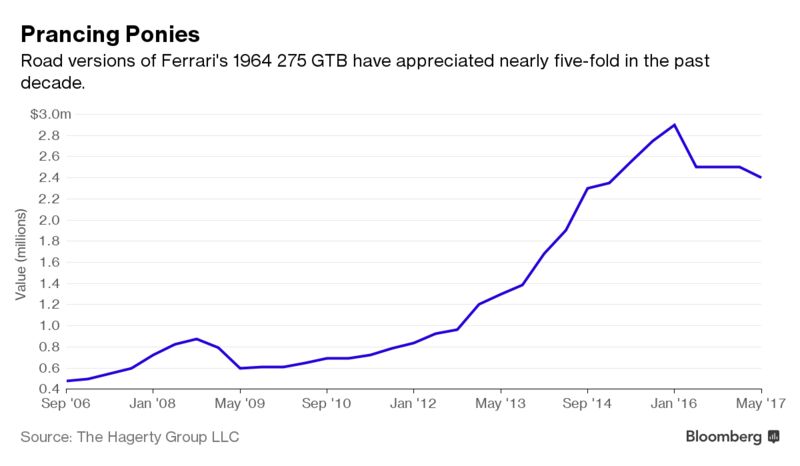 A few of these machines, however, were built for racing and
stamped with a “C”—for “Competizione”—and "Speciale" (lest one think it
common). Closer in lineage to the GTO Ferraris that took Europe's
racetracks by storm in the early 1960s, the "special" 275 GTBs had
thinner body panels and a more spindly infrastructure, a metal diet that
trimmed 300 pounds in all. Its engine was mounted lower in the body for
better handling. With six carburetors, one for every two cylinders, the
car produced 330 horsepower. At the time, that was forza with a capital F.
A few of these machines, however, were built for racing and
stamped with a “C”—for “Competizione”—and "Speciale" (lest one think it
common). Closer in lineage to the GTO Ferraris that took Europe's
racetracks by storm in the early 1960s, the "special" 275 GTBs had
thinner body panels and a more spindly infrastructure, a metal diet that
trimmed 300 pounds in all. Its engine was mounted lower in the body for
better handling. With six carburetors, one for every two cylinders, the
car produced 330 horsepower. At the time, that was forza with a capital F. What is it, emotionally?
To appreciate in multiples, a classic car needs more than good looks and snappy statistics; it needs a good back story—what collectors call provenance. Henn’s Ferrari is layered with the stuff. In 1965 it won its class at the 24 Hours of Le Mans, the World Series of motoring.For decades, Henn showed no interest in selling the machine. Rather, he displayed it proudly at his Swap Shop, a giant flea market and drive-in movie theater complex in Fort Lauderdale, Fla. (At the moment, the joint is fittingly showing The Fate of the Furious.) A slightly eccentric owner never hurt the value of a car either (see: Joplin, Janis), and Henn falls squarely in that camp. In addition to being a profligate collector, the flea-market magnate ran a racing team and was a respected wheelman in his own right.
"About 10 years ago, he got an offer from a big Japanese collector for 35 to 40 million euros," recalled Ron Vogel, a friend and racing buddy. "I think he responded, ‘Stop talking to me.' "
For Ferrari, he was both a devoted customer and a provocateur. Vogel said Henn repeatedly rejected Ferrari's offers to show the vehicle at its own museum. When Fiat Chrysler rejected his bid to buy the ultra-rare LaFerrari Aperta (and returned his $1 million check), Henn sued the company for defamation. He eventually dropped the suit, telling Road & Track: "It ain't [about] the f---ing car."

Preston Henn, at Florida's Homestead-Miami Speedway, was both a champion and a provocateur of the Ferrari brand.
Photographer: Mark Elias/Bloomberg
What is it, financially?
What is Henn's 275 GTB/C Speciale worth? Well, what someone is willing to pay for it. Brian Rabold, vice president of valuation for the Hagerty Group, said it doesn't have the historical racing significance of Ferrari's coveted early GTOs. But it's a better car and more rare—one of only three.At auction in 2014, one of its siblings fetched $29.4 million. Rabold said Henn's Speciale would fetch between $50 million and $75 million.
"But there could be someone that surprises," he said. "This is a once-in-a-lifetime opportunity, and I'm certain there are people who have long been interested in this car."
Whether the vehicle finds its way to the market, meanwhile, remains to be seen. Henn is survived by his wife of more than 60 years, Betty, and four children. Before passing, he told Autoweek that he made sure the Ferrari will stay on display at the Swap Shop long after he is gone.
"That was his crown jewel," Vogel said. "At one point he said he wanted to be buried in it."
If you are really keen on Ferraris from the 1960s, pick one up for $200,000—say a 300 GT. At that price, one could justifiably drive it down to Fort Lauderdale and ogle Henn's precious machine for free.
Subscribe to:
Posts (Atom)