WRTLHD Stock News

WRLTHD Stock News

WRLTHD News Feed

Michael Phelps makes history! Wins 22nd Olympic gold medal


(CNN)Michael Phelps is used to rewriting history -- now he's eclipsing it too.
 
You have to go back around 2,160 years, give a week or two, to find an athlete who could challenge the imperious record held by the "Baltimore Bullet."
 
The US star claimed the 22nd Olympic gold of his Olympic career Thursday after powering past the opposition in the final of the 200-meter individual medley. 
 
That victory, the 13th individual triumph of his Olympics career, meant he surpassed the greatest athlete of ancient Greece and indeed of the Games -- Leonidas of Rhodes.
 
Phelps, who took his tally to four gold medals at Rio by winning the event for the fourth consecutive 
Games, moved ahead of Leonidas after edging out Japan's Kosuke Hagino and China's Wang Shun.
 
The achievements of Leonidas, a runner who competed between 164 and 152 BC, were recorded by Philostratus the Athenian and Pausanias who told of his 12 triumphs, according to the official Olympics website.
 
Perhaps in another 2,000 years the stories of Phelps and his exploits will be shared around the table given his astonishing record.
 
The most decorated Olympian of all-time with 26 medals made a mockery of suggestions that he would struggle to cope with teammate Ryan Lochte and Japan's Hagino.
 
Phelps didn't just win -- he smashed it. Then he jumped out of the pool to receive his medal before heading back in to qualify for Friday's 100-meter butterfly final.
 
The 31-year-old, who is set to retire after the Games, could end up with five gold medals by the end of the competition.
 
Phelps wasn't the only gold medal winner for the US on a stunning night of swimming.


China developing a hypersonic jet: Could drastically cut the cost of space travel


By MailOnline Reporter
China is developing a hypersonic aircraft to take pilots, and perhaps even passengers, to the edge of space.

A state aerospace firm has reportedly begun research on an aircraft capable of taking off from a runway and carrying a crew into low Earth orbit.

The design is purported to be a more efficient successor to Nasa’s Space Shuttle, which was launched on a rocket but landed on a runway.

The new space plane is being developed by the China Aerospace Science and Technology Corporation (CASTC).

When completed it could dramatically reduce the costs of space travel and give China a boost in the renewed space race.

According to Popular Science, the aircraft would take off like a normal plane, before a supersonic scramjet engine kicks in to lift it to almost 100 km above sea level.

At this point, rocket boosters will provide the additional thrust, giving it enough power to escape the clutches of Earth's lower atmosphere.

Plans for the plane were discussed on state broadcaster CCTV, with a plane entering service by 2030.

With Nasa's Space Shuttle programme decommissioned since 2011, a hybrid space plane could give the Chinese an edge in the space race.

Details are sketchy at this early stage, but the craft could potentially hit speeds of Mach 5, reports Popular Science.

It comes just a few weeks after Russia revealed it was developing a hypersonic aircraft capable to travelling anywhere in the world in two hours.

The European Space Agency has also been funding research into a revolutionary Sabre Engine capable to propelling an aircraft at 4,000 mph.

China is reportedly developing a hypersonic aircraft (pictured) capable of carrying those on board into low Earth orbit. The move could drastically reduce the cost of space travel, it is claimed

Michael Phelps Wins His 19th Gold Medal

Photo
Credit Doug Mills/The New York Times
RIO DE JANEIRO — Michael Phelps won his 19th Olympic gold medal as the United States won the 4x100 relay at the Olympics on Sunday. The Americans’ traditional rival in the event, France, was second, and Australia third.
Photo
Credit Doug Mills/The New York Times
Photo
Credit Francois-Xavier Marit/Agence France-Presse — Getty Images
The gold was Phelps’s 23rd medal: 19 golds, 2 silvers and 2 bronzes. The final time was 3:09.92.

Phelps swam the second leg for the Americans, taking over from Caeleb Dressel in second place behind France and swimming into the lead. His split time was a strong 47.12. Ryan Held and Nathan Adrian brought the U.S. home; Adrian’s split was an even better 46.97.

Usually the American 4x100 team is made up of the top finishers from the 100 free at the Olympic Trials. Phelps chose not to contest that event, but was put on the relay team anyway.
Photo
Credit Doug Mills/The New York Times
Photo
Credit Patrick B. Kraemer/European Pressphoto Agency
Phelps retired after the 2012 Games but decided to return in part because of disappointment with how the American men swam in the 4x100 relay at the 2013 world championships, losing to France.

The relay was the most unpredictable event of the night in swimming, with Australia, France, the United States and Russia all having claims to a gold medal. France and the United States split the last two Olympic gold medals, with Yannick Agnel of France outdueling Ryan Lochte in the anchor leg to win four years ago. Phelps was on both of those American teams.
Photo
Credit Doug Mills/The New York Times

Alligator drags child in lake at Disney resort, deputies say


Child dragged into Seven Seas Lagoon
WALT DISNEY WORLD, Fla. - A 2 year old child was dragged by an alligator into the water at the Grand Floridian Hotel at Walt Disney World, the Orange County Sheriff's Office said.

The incident happened around 9:30 p.m. Tuesday.


Deputies are searching the waters and put crime-scene tape around the water.

Silva said the child has not been found.Witnesses as well as Florida Fish & Wildlife officials reported that the alligator was about 7 feet long.

Welcome, Olympic Tourists, to Brazil. Please Don’t Mind the Mess

by
When Rio de Janeiro won the rights in 2009 to host the Olympics, Brazil planned a blitz of projects to showcase just how far it had risen. But when tourists start showing up in two months to attend the games, it’ll be the bust and not Brazil’s best that’ll be on display.

That sewage-filled harbor that visitors will pass on the way from the airport -- and the spot where Olympic sailing events will be staged -- was supposed to be a shimmering, clean bay. That new metro line they’ll take from the posh Ipanema beach neighborhood to the games will at best run on a limited schedule, having started operations just four days before the opening ceremony. And what about the state-of-the-art gear that police were s

upposed to get to help keep travelers safe? A top official says it never happened.

Welcome to Brazil, a land of political, economic and fiscal crisis.

“When you look back at the bid documents from 2009, the Olympics were definitely designed and pitched as a way of showcasing Brazil as this thriving democracy and burgeoning economy,” said Jules Boykoff, the author of a book on Olympics history that’s critical about the legacy of major sporting events. “How big a difference seven years make.”

To be fair, most of the 39 billion reais ($11 billion) in arenas and infrastructure being built ahead of the Olympics will be ready in time and, besides a few eyesores and commuting delays, most tourists may not even notice all that should have been. But the unfinished work is an indication of a much bigger problem that will last long after the visitors jet out: Rio state is all but broke.

No one knows that better than Joao Vitor da Silva and his father, Rodrigo da Silva. The scrawny nine-year-old in an Iron Man T-shirt is a hemophiliac, and Batista said they’ve been warned that public-health spending cuts may disrupt supplies of prophylaxis, the shots that prevent Joao from bleeding out whenever he’s injured or sick.

 “If there’s money for the Olympics, there has to be money for health,” said Da Silva, a 34-year-old former forklift-operator who’s on medical leave.

Brazil’s hardly the first nation to host the Olympics games from a hotbed of chaos. (Russia, Mexico and South Korea are all part of the club.) Even so, the tumultuous backdrop when the games begin Aug. 5 is a far cry from the image of the up-and-coming powerhouse organizers had envisioned when hosting rights were awarded.

These days, Brazil is stuck in a crushing recession and Lula’s successor, Dilma Rousseff, was stripped of power while she faces an impeachment trial on allegations she illegally financed budget deficits. Rio state missed debt payments last month and is delaying public-worker salaries after oil prices collapsed, a primary source of revenue. And at least six companies contracted for Olympic projects and related infrastructure have been crippled by allegations they paid kickbacks to win lucrative public-works deals.

Three of those companies -- builders Queiroz Galvao SA, OAS SA, and Andrade Gutierrez SA -- were responsible for a project to dredge four polluted lagoons and plant 500,000 mangrove trees in Barra da Tijuca, the key staging ground for the games. But work won’t be ready after public prosecutors requested delays and then the state faced cash shortages, according to the Environment Secretariat. A press official for the builders group confirmed that the pace of work has been “reduced” and declined to comment further.

“Rio is the showcase of Brazil -- of its incompetence and impunity,” said Mario Moscatelli, the biologist subcontracted by the construction firms to plant the mangroves. He says he’ll be able to finish less than 10 percent of the work.

Queiroz is also part of the group building the subway line from Ipanema to Barra, which still awaits a nearly 1 billion-real loan from the Rio-based national development bank before it can finish works.

Rio state projects a 20 billion-real deficit this year, of which 12 billion relate to the underwater pension system, and Thursday announced a new round of spending cuts. Almost 70 percent of public-school teachers and workers have been on strike since March as salaries are delayed, their union says. Rio city was forced to take control of two public hospitals, and a doctors’ group warns others may soon close for lack of funding.

The state also slashed its security budget by 32 percent this year and has delayed payments to police and their families. New equipment police expected for the games never materialized, and instead many officers are saddled with obsolete gear, said a high-ranking military police official, who asked not to be identified criticizing the budget cuts.

All major security investments for the Olympics have been carried out since 2012 or are in their final phase, and any personnel or equipment shortage during the games will be covered by federal security agencies, according to the press office of Rio’s security secretariat.

Leonardo Espindola, chief of staff to Rio’s governor, told the Supreme Court in April that the state is on the verge of “social collapse.” State Finance Secretary Julio Bueno agrees. At the outset of an hour-long interview last month, Bueno claimed to have “the worst job in Rio de Janeiro.”

“We’re unable to maintain essential services like police and health,” he said. “That’s what defines the health of a society.”

Muhammad Ali, 'The Greatest of All Time', Dead at 74

Muhammad Ali, the silver-tongued boxer and civil rights champion who famously proclaimed himself "The Greatest" and then spent a lifetime living up to the billing, is dead.

Ali died Friday at a Phoenix-area hospital, where he had spent the past few days being treated for respiratory complications, a family spokesman confirmed to NBC News. He was 74.
"After a 32-year battle with Parkinson's disease, Muhammad Ali has passed away at the age of 74. 
The three-time World Heavyweight Champion boxer died this evening," Bob Gunnell, a family spokesman, told NBC News.

Ali had suffered for three decades from Parkinson's Disease, a progressive neurological condition that slowly robbed him of both his legendary verbal grace and his physical dexterity. A funeral service is planned in his hometown of Louisville, Kentucky.

Even as his health declined, Ali did not shy from politics or controversy, releasing a statement in December criticizing Republican presidential candidate Donald Trump's proposal to ban Muslims from entering the United States. "We as Muslims have to stand up to those who use Islam to advance their own personal agenda," he said.

The remark bookended the life of a man who burst into the national consciousness in the early 1960s, when as a young heavyweight champion he converted to Islam and refused to serve in the Vietnam War, and became an emblem of strength, eloquence, conscience and courage. Ali was an anti-establishment showman who transcended borders and barriers, race and religion. His fights against other men became spectacles, but he embodied much greater battles.

Born Cassius Clay on Jan. 17, 1942 in Louisville, Kentucky, to middle-class parents, Ali started boxing when he was 12, winning Golden Gloves titles before heading to the 1960 Olympics in Rome, where he won a gold medal as a light heavyweight.

He turned professional shortly afterward, supported at first by Louisville business owners who guaranteed him an unprecedented 50-50 split in earnings. His knack for talking up his own talents — often in verse — earned him the dismissive nickname "the Louisville Lip," but he backed up his talk with action, relocating to Miami to train with the legendary trainer Angelo Dundee and build a case for getting a shot at the heavyweight title.


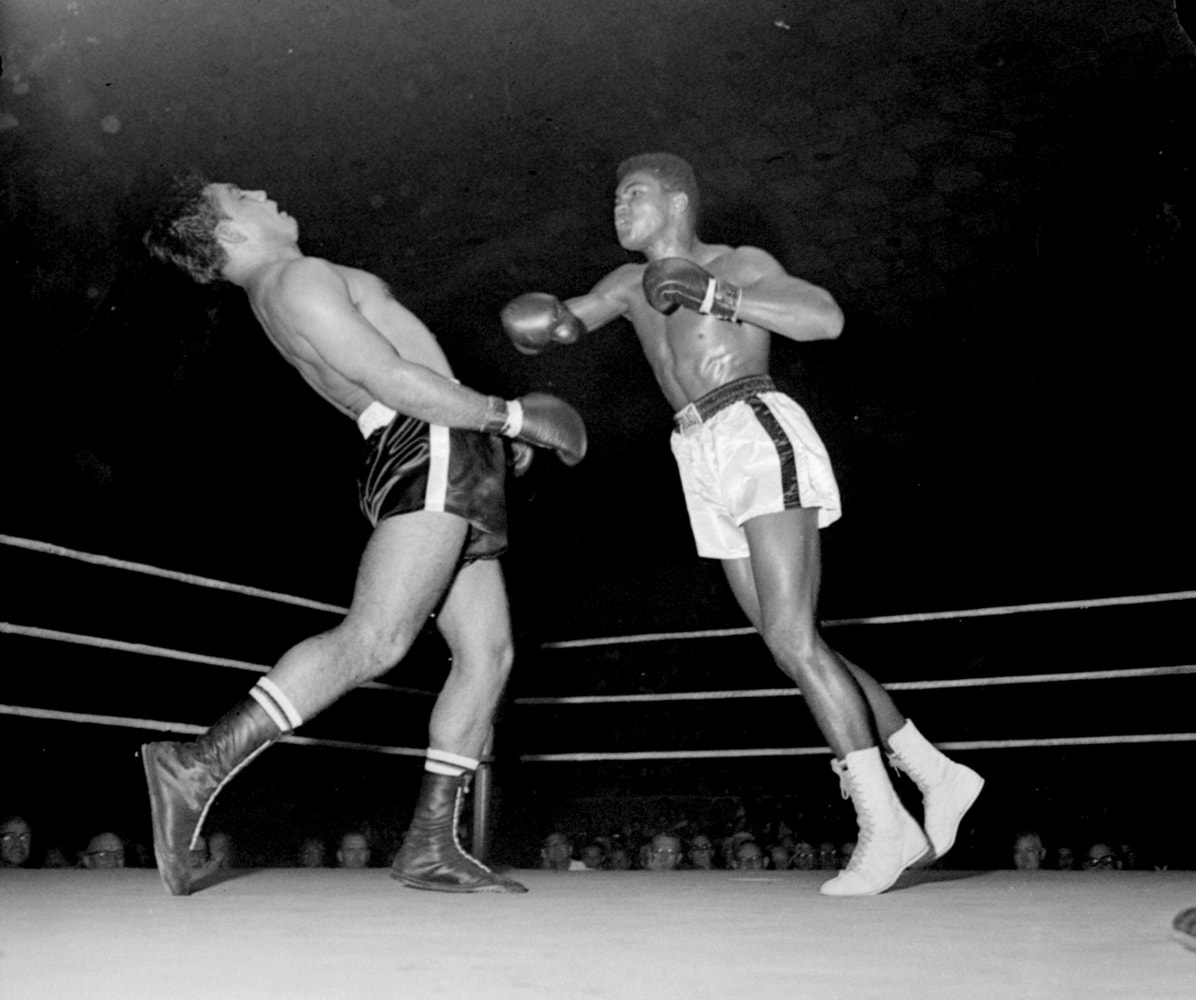
Image: Muhammad Ali


Muhammad Ali, right, attacks Alex Mitoff in the sixth round in which Ali clobbered the Argentinean to the canvas, on Oct. 7, 1961 in Louisville, Ky. H.B. Littell / AP, file
As his profile rose, Ali acted out against American racism. After he was refused services at a soda fountain counter, he said, he threw his Olympic gold medal into a river.

Recoiling from the sport's tightly knit community of agents and promoters, Ali found guidance instead from the Nation of Islam, an American Muslim sect that advocated racial separation and rejected the pacifism of most civil rights activism. Inspired by Malcolm X, one of the group's leaders, he converted in 1963. But he kept his new faith a secret until the crown was safely in hand. 

That came the following year, when heavyweight champion Sonny Liston agreed to fight Ali. The challenger geared up for the bout with a litany of insults and rhymes, including the line, "float like a butterfly, sting like a bee." He beat the fearsome Liston in a sixth-round technical knockout before a stunned Miami Beach crowd. In the ring, Ali proclaimed, "I am the greatest! I am the greatest! I'm the king of the world." 

A Controversial Champion
The new champion soon renounced Cassius Clay as his "slave name" and said he would be known from then on as Muhammad Ali — bestowed by Nation of Islam founder Elijah Muhammad. He was 22 years old.


The move split sports fans and the broader American public: an American sports champion rejecting his birth name and adopting one that sounded subversive.
Ali successfully defended his title six times, including a rematch with Liston. Then, in 1967, at the height of the Vietnam War, Ali was drafted to serve in the U.S. Army.

He'd said previously that the war did not comport with his faith, and that he had "no quarrel" with America's enemy, the Vietcong. He refused to serve.

"My conscience won't let me go shoot my brother, or some darker people, some poor, hungry people in the mud, for big powerful America, and shoot them for what?" Ali said in an interview. "They never called me nigger. They never lynched me. They didn't put no dogs on me."

His stand culminated with an April appearance at an Army recruiting station, where he refused to step forward when his name was called. The reaction was swift and harsh. He was stripped of his boxing title, convicted of draft evasion and sentenced to five years in prison.

Released on appeal but unable to fight or leave the country, Ali turned to the lecture circuit, speaking on college campuses, where he engaged in heated debates, pointing out the hypocrisy of denying rights to blacks even as they were ordered to fight the country's battles abroad.

"My enemy is the white people, not Vietcongs or Chinese or Japanese," Ali told one white student who challenged his draft avoidance. "You my opposer when I want freedom. You my opposer when I want justice. You my opposer when I want equality. You won't even stand up for me in America for my religious beliefs and you want me to go somewhere and fight but you won't even stand up for me here at home."

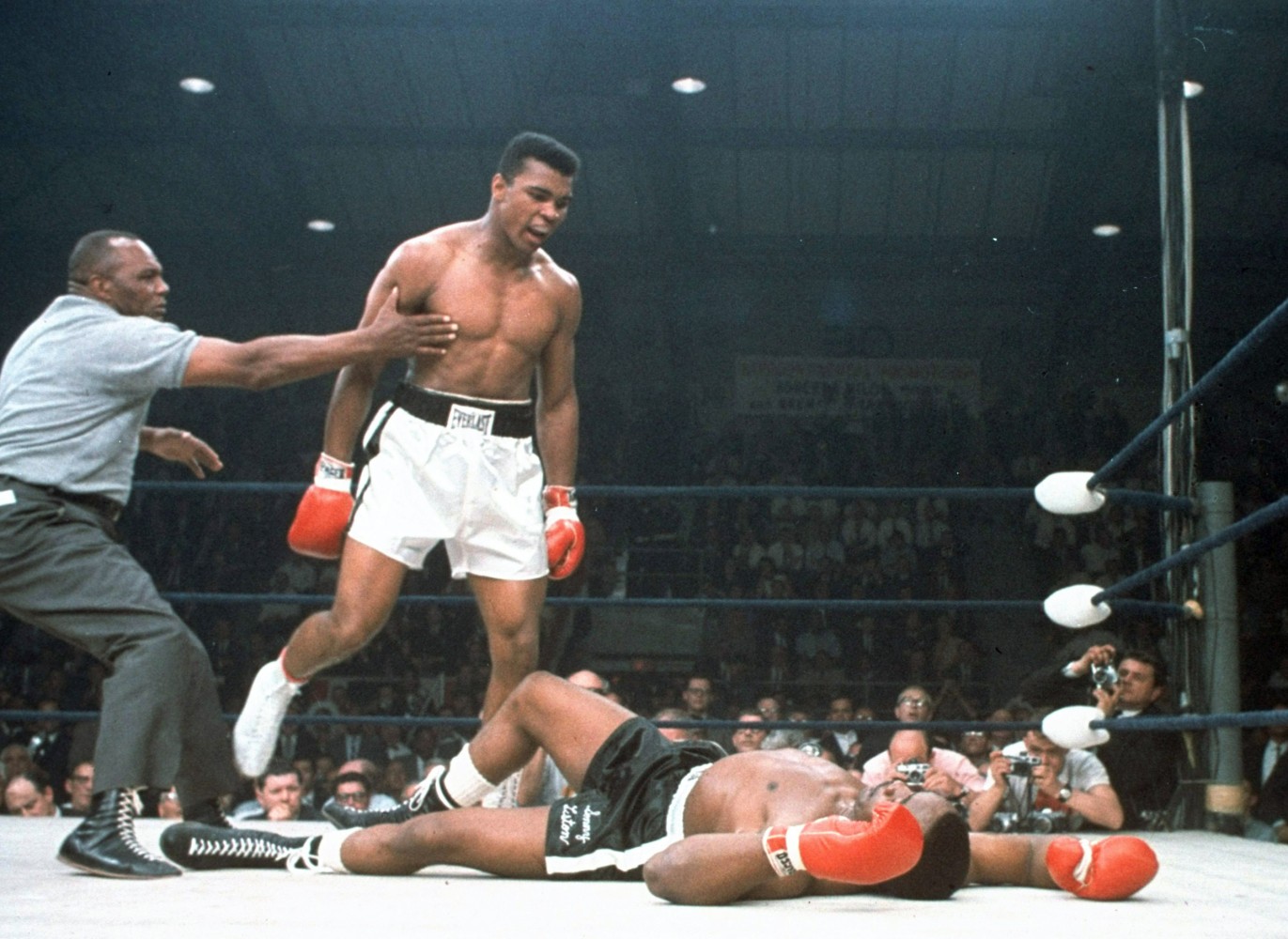
Muhammad Ali; Sony Liston


Muhammad Ali is held back by referee Joe Walcott, left, after Ali knocked out challenger Sonny Liston in the first round of their title fight in Lewiston, Maine on May 25, 1965. AP, file
Ali's fiery commentary was praised by antiwar activists and black nationalists and vilified by conservatives, including many other athletes and sportswriters.

His appeal took four years to reach the U.S. Supreme Court, which in June 1971 reversed the conviction in a unanimous decision that found the Department of Justice had improperly told the draft board that Ali's stance wasn't motivated by religious belief.

Return to the Ring
Toward the end of his legal saga, Georgia agreed to issue Ali a boxing license, which allowed him to fight Jerry Quarry, whom he beat. Six months later, at a sold-out Madison Square Garden, he lost to Joe Frazier in a 15-round duel touted as "the fight of the century." It was Ali's first defeat as a pro.

That fight began one of boxing's and sport's greatest rivalries. Ali and Frazier fought again in 1974, after Frazier had lost his crown. This time, Ali won in a unanimous decision, making him the lead challenger for the heavyweight title.

He took it from George Foreman later that year in a fight in Zaire dubbed "The Rumble in the Jungle," a spectacularly hyped bout for which Ali moved to Africa for the summer, followed by crowds of chanting locals wherever he went. A three-day music festival featuring James Brown and B.B. King preceded the fight. Finally, Ali delivered a historic performance in the ring, employing a new strategy dubbed the "rope-a-dope," goading the favored Foreman into attacking him, then leaning back into the ropes in a defensive stance and waiting for Foreman to tire. Ali then went on the attack, knocking out Foreman in the eighth round. The maneuver has been copied by many other champions since.

The third fight in the Ali-Frazier trilogy followed in 1975, the "Thrilla in Manila" that is now regarded as one of the best boxing matches of all time. Ali won in a technical knockout in the 15th round.

Ali successfully defended his title until 1978, when he was beaten by a young Leon Spinks, and then quickly took it back. He retired in 1979, when he was 37, but, seeking to replenish his dwindling personal fortune, returned in 1980 for a title match against Larry Holmes, which he lost. Ali lost again, to Trevor Berbick, the following year. Finally, Ali retired for good.


Image: Muhammad Ali Trevor Berbick

Muhammad Ali, right, takes a punch from Trevor Berbick, of Canada, during the first round of their 10-round bout in Nassau, Bahamas, in this Dec. 11, 1981 file photo. AP, file
'He's Human, Like Us'The following year, Ali was diagnosed with Parkinson's Disease."I'm in no pain," he told The New York Times. "A slight slurring of my speech, a little tremor. Nothing critical. If I was in perfect health — if I had won my last two fights — if I had no problem, people would be afraid of me. Now they feel sorry for me. They thought I was Superman. Now they can go, 'He's human, like us. He has problems.' ''

Even as his health gradually declined, Ali — who switched to more mainstream branches of Islam — threw himself into humanitarian causes, traveling to Lebanon in 1985 and Iraq in 1990 to seek the release of American hostages. In 1996, he lit the Olympic flame in Atlanta, lifting the torch with shaking arms. With each public appearance he seemed more feeble, a stark contrast to his outsized aura. He continued to be one of the most recognizable people in the world.

He traveled incessantly for many years, crisscrossing the globe in appearances in which he made money but also pushed philanthropic causes. He met with presidents, royalty, heads of state, the Pope. He told "People" magazine that his largest regret was not playing a more intimate role in the raising of his children. But he said he did not regret boxing. "If I wasn't a boxer, I wouldn't be famous," he said. 
"If I wasn't famous, I wouldn't be able to do what I'm doing now."

In 2005, President George W. Bush honored Ali with the Presidential Medal of Freedom, and his hometown of Louisville opened the Muhammad Ali Center, chronicling his life but also as a forum for promoting tolerance and respect.

Divorced three times and the father of nine children — one of whom, Laila, become a boxer — Ali married his last wife, Yolanda "Lonnie" Williams, in 1986; they lived for a long time in Berrien Springs, Michigan, then moved to Arizona.

In recent years, Ali's health began to suffer dramatically. There was a death scare in 2013, and last 
year he was rushed to the hospital after being found unresponsive. He recovered and returned to his new home in Arizona.

In his final years, Ali was barely able to speak. Asked to share his personal philosophy with NPR in 2009, Ali let his wife read his essay:

Invictus Games 2016 Orlando


Photo's and story by Ray Tharaldson
 
WE CAME.
WE SAW.
WE'RE UNCONQUERED.

"I am absolutely delighted that the United States has taken up that challenge and will host the next Invictus Games in 2016. I have no doubt that the USA will set the bar even higher than London did and put on a great show." Prince Harry.

The Invictus Story


Most of us will never know the full horrors of combat. Many Servicemen and women suffer life-changing injuries, visible or otherwise, whilst serving their country. How do these men and women find the motivation to move on and not be defined by their injuries?
 
How can they be recognized for their achievements and not given sympathy? Prince Harry asked these questions. On a trip to the Warrior Games in the USA in 2013 he saw how the power of sport could help physically, psychologically and socially. His mind was made up. London would host the inaugural Invictus Games, an international sporting event for wounded, injured and sick Service personnel.
 
The word ‘Invictus’ means ‘unconquered’. It embodies the fighting spirit of the wounded, injured and sick service personnel and what these tenacious men and women can achieve, post injury. The Games harness the power of sport to inspire recovery, support rehabilitation, and generate a wider understanding and respect for those who serve their country.

These Games have shone a spotlight on the ‘unconquerable’ character of service men and women and their families and their ‘Invictus’ spirit. These Games have been about seeing guys sprinting for the finish line and then turning round to clap the last man in. They have been about teammates choosing to cross the line together, not wanting to come second, but not wanting the other guys to either. These Games have shown the very best of the human spirit. Prince Harry
.

In the words of Prince Harry of England, “Invictus means unconquered, a word which perfectly embodies the fighting spirit of the wounded, injured and sick service personnel and veterans.”

Prince Harry has been the inspiration and creator of the Invictus Games and did so after a visit he made to the United States in 2013 to attend the “Warrior Games”. It was at that point in time that he realized and “fully appreciated” that sport played a vital role in helping with the recovery process.

Prince Harry's description of the meaning of the Invictus Games sums it up most eloquently: “I believe there is more support we can and should give to these incredible men and women. Reassuring them that their service will not be forgotten and that they have every opportunity to make a full and meaningful contribution to the communities in which they live.”

Every competitor overcame triumphant battles at some level, just to be afforded the opportunity to be at the starting line but what transpires is the most outstanding showcase of competition, camaraderie and the very best of the human spirit.
 
In the words of Ken Fisher, Chairman of the Invictus Games 2016 along with Fisher House: “These games will serve as a powerful reminder that wounded, ill, and injured servicemen and women and their families are not alone. They will be able to share their experiences with each other as only they can. Treating physical and psychological trauma is just one step on the long road to recovery, recovery that is about rediscovering self-confidence,personal ambition, and most importantly, family healing. THAT is the spirit of the INVICTUS GAMES. They truly are unconquered.” (emphasis added)

Mary Louise and I recently had the pleasure and honor to attend the Annual Invictus Games being held at ESPN Wide World of Sports at Disney World Orlando. While we were there with the initial intent of meeting the recipient of the Orlando Rocks Benefit for 2017; with tickets purchased and eager to go, we came to find out that the warrior would not be competing due to prosthetic issues. We attended just the same. Below is the account of our day with all the warriors. Enjoy folks!

In the words of Prince Harry of England, “Invictus means unconquered, a word which perfectly embodies the fighting spirit of the wounded, injured and sick service personnel and veterans.”

Prince Harry has been the inspiration and creator of the Invictus Games and did so after a visit he made to the United States in 2013 to attend the “Warrior Games”. It was at that point in time that he realized and “fully appreciated” that sport played a vital role in helping with the recovery process.

Prince Harry's description of the meaning of the Invictus Games sums it up most eloquently: “I believe there is more support we can and should give to these incredible men and women. Reassuring them that their service will not be forgotten and that they have every opportunity to make a full and meaningful contribution to the communities in which they live.”

Every competitor overcame triumphant battles at some level, just to be afforded the opportunity to be at the starting line but what transpires is the most outstanding showcase of competition, camaraderie and the very best of the human spirit.

In the words of Ken Fisher, Chairman of the Invictus Games 2016 along with Fisher House: “These games will serve as a powerful reminder that wounded, ill, and injured servicemen and women and their families are not alone. They will be able to share their experiences with each other as only they can. Treating physical and psychological trauma is just one step on the long road to recovery, recovery that is about rediscovering self-confidence,personal ambition, and most importantly, family healing. THAT is the spirit of the INVICTUS GAMES. They truly are unconquered.” (emphasis added)

On behalf of Mary Louise and myself, Raymond Tharaldon, we hope you enjoy our showcase of photos and undying devotion and we would like to say “thank you” to ALL these American and international heroes.