WRTLHD Stock News

WRLTHD Stock News

WRLTHD News Feed

The Wounded Warrior Spirit (Sgt. Maj. Raymond Mackey)


Photo by Sgt. Mark Fayloga


Story by Lance Cpl. Chelsea Flowers 
Sgt. Maj. Raymond Mackey, Sierra Vista, Ariz., East Team, searches for an open teammate during a game against the East Team during the 2012 Marine Corps Trials, hosted by the Wounded Warrior Regiment, at Marine Corps Base Camp Pendleton, Calif., Feb. 17, 2012. Wounded Warrior Marines, veterans and allies are competing in the second annual trials, which include swimming, wheelchair basketball, sitting volleyball, track and field, archery and shooting. The top 50 performing Marines will earn the opportunity to compete in the Warrior Games in Colorado Springs in May.
CAMP PENDLETON, Calif. - Sgt. Maj. Raymond Mackey, Sierra Vista, Ariz., has been in the Marine Corps for 29 years but will be the first to tell you he can still hang with even the youngest Marines on the basketball court. As he quickly maneuvers his wheelchair by other players to get open for a pass, puts up shots in the key and shouts directions to others on his team, it is easy to see that Mackey is a natural-born leader – as an athlete, a Marine and a Wounded Warrior. For the past two years, Mackey has mentored and inspired other injured Marines he met while at Walter Reed National Military Medical Center in Maryland. It is these Marines who are now playing and competing alongside Mackey because of his gentle prodding and unwavering example. With every step he takes on his prosthetic legs and every push of the wheels on his wheelchair, Mackey is showing them what it means to be a Wounded Warrior.


While deployed to Afghanistan with 3rd Battalion, 10th Marine Regiment, in 2009 Mackey’s unit came under fire while on patrol. While returning fire and moving for cover through a ditch, the Marine directly in front of Mackey stepped on the trigger mechanism of an improvised explosive device, causing it to detonate. The IED explosion funneled in the ditch, spreading out instead of up, and hit Mackey harder than the Marines around him. Most of the Marines suffered class four concussions and shrapnel wounds. Mackey lost both of his legs. But this setback did not change Mackey’s desire to lead and mentor Marine. This same desire prompted Mackey to compete with more than 300 other wounded Marine, veterans and allies in the 2012 Marine Corps Trials.


Following wheelchair basketball practice, Mackey took a few minutes to talk about his recovery and his passion for Marines.


Q: Do you think the term 'Wounded Warrior' is a good way to describe you and other wounded Marines?


A: All of us have been wounded in one way or another — some of them are silent, some of them are not. Some of them are obvious like myself and a couple of the others who have amputations and then you have the guys with post traumatic stress disorder and the traumatic brain injury; they’re wounded as well.


Q: What motivated you to come and participate in the 2012 Marine Corps Trials?


A: I was at Bethesda when a lot of these Marines came in. I’m the one who kind of talked them into going. So, if I didn’t show up, I’d be just another person telling them to do something I wasn’t doing myself. I came out here just for them.


Q: Do you think you are able to compete with younger Marines on the court?


A: Hopefully one day, one of these younger guys are inspired to say, ‘I want to be like the sergeant major was on the basketball court. I want to be able to turn my wheelchair in the air and go back the other way.’ That’s the impact I want to have.


Q: What do you hope is the outcome of the 2012 Marine Corps Trials?


A: My hope is that the East Coast will take home the Commander’s Cup. I want bragging rights. And I’m hoping that whomever gets selected to go to the Warrior Games will bring home the cup again.


Q: What are your plans for the future?


A: You never quit being a Marine. I’m hoping to somehow still help Marines. I’m just not one who can sit still, so I’m going to try to get a job on base at Camp Lejeune where I can help Marines. It doesn’t matter what I’m doing because Marines are Marines. Sometimes they need help and sometimes they need guidance. Somehow, I’ll help Marines down there, whether it’s inspiring them or helping them buy cars and simple things like that.


Q: What would you like to pass on to younger wounded Marines?


A: I want to inspire them. You can motivate anybody, but to inspire somebody is completely different. You can motivate these guys to come out here and play this game, but if you inspire them, it’s going to last a lifetime.


For more information visit;

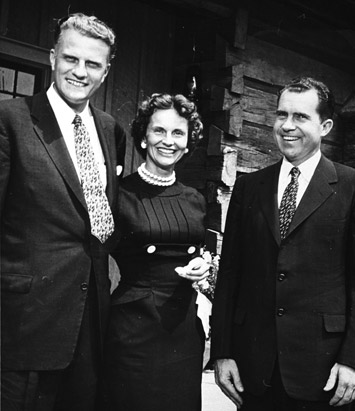
Billy Graham: Pastor to Presidents

Short stories and a photo collection
February 19, 2012 - Every U.S. President since World War II has met with Billy Graham. Both Johnson and Nixon, the two who probably sought him the most, offered him high positions in government — which he quickly and politely refused.

Billy Graham has often said, "Whether the story of Christ is told in a huge stadium, across the desk of a powerful leader, or shared with a golfing companion, it satisfies a common hunger. All over the world, whenever I meet people face-to-face, I am made aware of this personal need among the famous and successful, as well as the lonely and obscure."

Every U.S. President since World War II through Barack Obama has met with Billy Graham. Here are short snippets of their stories:

Harry S. Truman — In 1950 a congressman called Billy and asked, "Would you like to meet the President?" Without any briefing on protocol, he agreed and went in with three colleagues and spoke with President Truman, who told Billy he lived by the Sermon on the Mount. Before he left, the two prayed together. Years later, Truman warmly received Billy at his home in Independence, Missouri.

Dwight D. Eisenhower — "Eisenhower was the first President that really asked my counsel in depth when he was sending troops into Little Rock," said Mr. Graham. Just before Eisenhower died, Billy was invited to see him at Walter Reed Hospital. After talking again about assurance of salvation, the two men prayed. Eisenhower then said he was ready to die.

"Billy Graham is one of the best ambassadors our country has but he told me, 'I am an ambassador of heaven.'" — Dwight D. Eisenhower

John F. Kennedy — Four days before he was inaugurated as President, John Kennedy invited Mr. Graham to spend the day with him in Palm Beach. "We drove around in JFK's white Lincoln convertible," said Billy. "During our conversations, I became aware that he was concerned about the moral and spiritual condition of the nation." During Kennedy's funeral service in the Capitol rotunda, Billy stood about 30 feet from Mrs. Kennedy and the family, and thought about the brevity of life and how people must prepare to meet God.

Lyndon B. Johnson — There was a religious side to Lyndon Johnson that people did not know. Billy was probably closer to Johnson than to any other President. He was invited to the family ranch several times and spent more than 20 nights at the White House during Johnson's administration. Every time Billy would say to him, "Let's have a prayer," the President would get on his knees to pray.

"My mind went back to those lonely occasions at the White House when your friendship helped to sustain a President in an hour of trial." — Lyndon Johnson in a letter to Billy Graham

Richard M. Nixon — President Nixon and Billy had been personal friends since 1950. Nixon was a private and complex person, but beneath the surface, Billy found him to be warm and compassionate, quite different from popular caricatures. He was rooted in the teachings and prayers of his Quaker faith. Often he asked Billy to pray with him and read the Bible when he would visit. In the last year of Nixon's presidency, Billy did not get to see him. Someone on the White House later relayed that Nixon said, "Don't let Billy Graham near me, I don't want him tarred with Watergate."

Gerald R. Ford — Answering critics of his relationship with Billy, Gerald Ford said, "I've heard the comments from some sources that Billy mixes politics with religion. I never felt that and I don't think that thousands and thousands of people who listen to him felt that. Billy dropped by the Oval Office on several occasions while I was President. They were get-togethers of old friends. They had no political or other significance."

Jimmy Carter — "Billy and Ruth Graham have been to visit us both in the governor's mansion in Georgia and in the White House," said Jimmy Carter. "His reputation is above reproach or suspicion." Back in 1966, Carter chaired a BGEA film crusade in Americus, Ga., and when he was governor, served as an honorary chairman of the Atlanta Crusade.

Ronald W. Reagan — Billy met Ronald Reagan a year after he married Nancy. The two remained close friends. "I remember when Reagan was president of the Screen Actors Guild, a union leader, and a very strong Democrat," Billy said. On March 30, 1981, after the assassination attempt on President Reagan's life, Billy flew immediately to Washington, D.C., to comfort and pray with Mrs. Reagan, and do anything he could for the President.

"It was through Billy Graham that I found myself praying even more than on a daily basis ... and that in the position I held, that my prayers more and more were to give me the wisdom to make decisions that would serve God and be pleasing to Him." — Ronald Reagan

George H. W. Bush — Mr. Graham has said he found George H.W. Bush easy to talk to about spiritual issues, "easier than other Presidents I have met. He says straight out that he has received Christ as his Savior and that he is a born-again believer." Billy was with President and Barbara Bush at the White House in 1991, the night that the Gulf War began. "Billy Graham has been an inspiration in my life," said Bush. "It is my firm belief that no one can be President ... without understanding the power of prayer, without faith. And Billy Graham helped me understand that."

William J. Clinton — President Clinton once recalled, "When I was a small boy, about 12 years old, Billy Graham came to Little Rock, Arkansas, to preach a Crusade." Mr. Graham would not agree to segregate the audience racially, which made an impression on the young boy. When he was governor of Arkansas, Bill Clinton joined Billy Graham at a Little Rock Crusade in 1989. Mr. Graham also visited Clinton in the Oval Office after he became President.

"Billy and Ruth Graham have practiced the ministry of ... being friends with Presidents of both parties ... always completely private, always completely genuine." — William J. Clinton

George W. Bush — In his 1999 campaign autobiography, "A Charge to Keep," George W. Bush said a turning point in his faith came during a private talk with Billy Graham along the coast of Maine in 1985. Graham's words planted the "mustard seed in my soul" that eventually led to a decision to "recommit my heart to Jesus Christ," he wrote.

 Barack Obama — President Barack Obama visited Billy Graham at his Montreat, N.C. home at the end of his weekend mountain vacation in April 2010. He is the first sitting president to meet with Graham at his home, where the two of them had a private prayer time and some conversation. A White House spokesman said that the president was “extraordinarily gratified that he (Mr. Graham) took the time to meet with him.” Mr. Graham said he was pleased to have had the president visit his home.

Many of these stories were adapted from Billy Graham: God's Ambassador. Order a copy of this book from our online bookstore now!

For more information visit:

Whitney Houston's funeral: Bobby Brown did not attend

Image Credit: Ray Tamarra/WireImage.com

Bobby Brown was reportedly not in attendance at Whitney Houston’s funeral, but not for a lack of trying. People reports Brown was turned away from the ceremony Saturday at the New Hope Baptist Church in Newark, N.J. A source tells People: “Bobby was outside the church … he hugged his brother and then got in a car, and they drove him off … They wouldn’t allow him in.”
Another source says that Brown was invited to attend, and had planned to in order to support his daughter with Houston, Bobbi Kristina: “She wanted her dad to be there for her mom … She is not going to be happy that he was turned back.” Some even say Brown made it into the funeral, with HLN tweeting, “He walked by Whitney’s casket and then came back up the isle. His eyes were red, and his head was down.” Earlier, Al Sharpton, who is attending the funeral, tweeted: “I am at Whitney’s funeral. I spoke with Bobby Brown trying to calm him down and not distract from the services. Today is about Whitney!” Brown reportedly left in a Cadillac Escalade with children Landon and LaPrincia.

Glen Campbell brings audience to its feet at Grammys

By Steve Gorman Reuters

LOS ANGELES (Reuters) - Country music veteran Glen Campbell, diagnosed last year with Alzheimer's disease, had no trouble remembering words to his signature song as he gave a rousing performance of "Rhinestone Cowboy" at the Grammy Awards show on Sunday.

The 75-year-old entertainer took the stage with contemporary country stars The Band Perry and Blake Shelton, who preceded him with their own versions of two other Campbell hits, "Gentle on My Mind" and "Southern Nights."

Within moments, he had the celebrity-studded crowd at the Staples Center on their feet and singing along, including former Beatle Paul McCartney and guitarist Joe Walsh, who was seen dancing in the aisle with his wife, Marjorie.

Ever the showman, Campbell pointed his
microphone at the audience for each chorus, inviting them to join in on the line, "Like a Rhinestone Cowboy!" and the hall's musical luminaries all joyfully obliged.

The performance, delivered without a hitch, ended in a hail of cheers and applause as Campbell shouted, "Thank y'all so much!" then turned to leave the stage as the lights went down and could be heard gamefully asking, "Where do I go?"

Campbell, a five-time Grammy winner who had been suffering from short-term memory loss for years, revealed in a People magazine article in June that he had been diagnosed six months before as being in the early stages of Alzheimer's disease.

His wife, Kim, said then that the couple decided to go public with his diagnosis ahead of a final, farewell concert tour that he launched in the fall of 2011.


Campbell started out as a session guitarist for the Beach Boys and producer Phil Spector before rising to fame in the 1960s with hits that included "Wichita Lineman" and "By the Time I Get to Phoenix." Perhaps his best-known song, "Rhinestone Cowboy" was a No. 1 hit in 1975.

He hosted his own CBS variety show, the "Glen Campbell Goodtime Hour," from 1969 to 1972, and co-starred with John Wayne in the original 1969 movie version of "True Grit."

(Editing by Eric Beech)

The Band Perry On Being Part of History With Glen Campbell

photo's by Ray Tharaldson all rights reserved 2011

By Steve Baltin
The Band Perry have never been to the Grammy Awards before, but the Best New Artist nominees' initial appearance on the show will be a memorable one. "This is our first Grammys ever, so to be here as nominees and also performers was huge, that was level one. But to be part of truly a historic moment with Glen Campbell, we didn’t have to think twice," Kimberly Perry told Rolling Stone at Grammy rehearsals.

Kimberly is not overstating it when she calls the band's performance with Campbell historic. The country icon has made public his battle with Alzheimer's disease and has said both his current studio album and tour will be his last. And for the three Perry siblings – Kimberly, Reid and Neil – sharing the Grammy stage with him brings their music full circle in many respects.

"Our dad actually introduced us to Glen’s music. They were our first radio," Kimberly says. The Band Perry's proud parents are in L.A. this week, but they were not on hand when their musical children first rehearsed the medley of their own "Gentle On My Mind" and Campbell's  "Rhinestone Cowboy." "When we rehearsed this week on Tuesday, our parents could not stay in the room because they were bawling. They were crying their eyes out, they were so excited," Kimberly says.

The Perry siblings have felt right at home on stage with Campbell and his band. "It’s sometimes nerve-wracking whenever artists perform with another person’s band, another artists’ band, but it feels so good up there, you can tell they’ve been performing together for years and years," Reid Perry says. "And they’re a family band too, he has three or four of his kids backing him up. And of course we’re a family band too, so it’s kind of like a front porch jam up," Kimberly adds.

The trio are also tremendously excited about seeing Paul McCartney and Bruce Springsteen Sunday night – Kimberly calls McCartney "my favorite songwriter ever, hands down." Unfortunately they were not able to attend the MusiCares tribute to McCartney because they are spending the weekend on tour with Brad Paisley.

To the Perry siblings, that's just life. "Last year we were home about 20 days and the year before that about the same. So we’re busy, but we love it," Reid says. "We're a blue-collar act," Kimberly adds. "And I really feel one reason why we’re here on Sunday is because of all the hard work, and we’ve traveled as a family for the last decade. So it’s good to finally have that road lead here today."

To that end, the group is already hard at work on the follow-up to their self-titled debut. "I would say we’re probably two thirds of the way done," Kimberly says.  They've already given fans a little preview of the new material, including the songs "Jimmy" and "It Burns For You," though most people haven't figured that out.

"We even play some of the new stuff live to kind of get an actual reaction from it. Not just what we think it’s gonna be like, but we can actually see what real people are thinking about it," Reid says. Don't they worry about the new tracks ending up on You Tube? "We kind of sneak it in. We roll from one song to the next without announcing it’s a new song, so so far it’s a clean sweep on You Tube," Kimberly says.

Brazil Editor Killed in Rough Border Town

By BRADLEY BROOKS Associated Press
SAO PAULO February 13, 2012 (AP)

The editor-in-chief of a newspaper that crusaded against corruption in Brazil's rough border region with Paraguay was shot dead, police said Monday, just days after another slain journalist's body was found in a different state.

Paulo Rodrigues, 51, was approached by two men on a motorcycle while driving late Sunday through the town of Ponta Pora in Mato Grosso do Sul state, where his Jornal da Praca newspaper and Mercosulnews.com website are based, police said.

The gunmen fired 12 shots, five of which hit Rodrigues. He died in a hospital hours later.

Rodrigues' killing comes after the shooting death last Thursday in Rio de Janeiro state of Mario Lopes, who wrote against corruption on his website Vassouras na Net. Police said Lopes already survived one attempt on his life last year, when he was hit by five shots while inside his office. He continued writing.

The deaths come at a time when journalism is under threat in Brazil, according to watchdog groups.

Reporters Without Borders said in a January report that Brazil plummeted to 99th place last year on its ranking of freedom of the press in nations around the globe. That was a drop of 41 places from the year before, a tumble attributed to violence against journalists.

The New York-based Committee to Protect Journalists said six Brazilian journalists were killed in 2011.

Leo Veras, a photo journalist who worked alongside Rodrigues, said that despite his scathing articles on corruption, his shooting remains a mystery.

"He was a critic, but he was beloved. We don't understand this cowardly crime at all," Veras said by telephone. "The newspaper defends the poor in our city and Paulo criticized corruption, but he was respected by leaders."

Veras and other another journalist who worked with Rodrigues said they didn't know of any investigative story that would have prompted his killing, despite the region being known for drug and gun trafficking, in addition to political corruption.

"I don't think a drug trafficker is responsible for this — they don't really have the power nor would they want the attention. Whoever did this is either an idiot or is new to the area and trying to show off some power," he said.

Flavio Kayatt, the mayor of Ponta Pora where Rodrigues died and who in 2009 threatened to sue his newspaper for what he said were misleading articles on municipal corruption, said he considered Rodrigues one of the best journalists of the region.

"He was extremely competent and idealistic. We had to respect his opinions," Kayatt told the Campo Grande News in the state capital. "Of course, he had ideologies that didn't meet ours, but we had a good relationship."

The photo journalist Veras verified that Rodrigues and Kayatt were friendly and often met to discuss various issues facing the city.

"We've been sharply criticizing the mayor for eight years and have never been threatened," Veras said. "We're bewildered by this crime."

———

Associated Press writer Marco Sibaja contributed to this report from Brasilia.