
Ray Tharaldson: “It’s A Wonderful Life” and Jimmy Stewart
Ray Tharaldson: “It’s A Wonderful Life” and Jimmy Stewart: Special thanks to Amanda K Schalau for sharing this article! Color Photos by Raymond Tharaldson Just months after winning his 1941 Aca...


American News Broadcasting: Farewell President George H. Bush!
American News Broadcasting: Farewell President George H. Bush!: George H.W. Bush was a patriot who loved his country and served it throughout his life. He showed grace and compassion and now will shin...
Rupert Murdoch could buy Fox regional sports networks back from Disney at a discount of billions

The front-runner to buy 22 regional sports TV networks from Disney is the same company that sold them in the first place.
“New Fox,” the company that will remain after Rupert Murdoch sells $71.3 billion worth of 21st Century Fox assets to Disney, is the leading contender to buy back the RSNs it “sold” to Disney as part of the larger transaction, according to people familiar with the matter. Those networks broadcast the games of 44 professional teams from Major League Baseball, the National Basketball Association and the National Hockey League
Formal offers haven’t come in yet. As Sports Business Daily reported, Disney only recently sent out its bid book to prospective buyers. News that Fox was considering buying back the channels was previously reported by The Information.
But people familiar with the process, who asked not to be named because the negotiations are private, say New Fox is the most serious buyer for all the networks. That’s a cleaner outcome for Disney than selling the networks piecemeal, which would bring in smaller buyers and private equity firms.
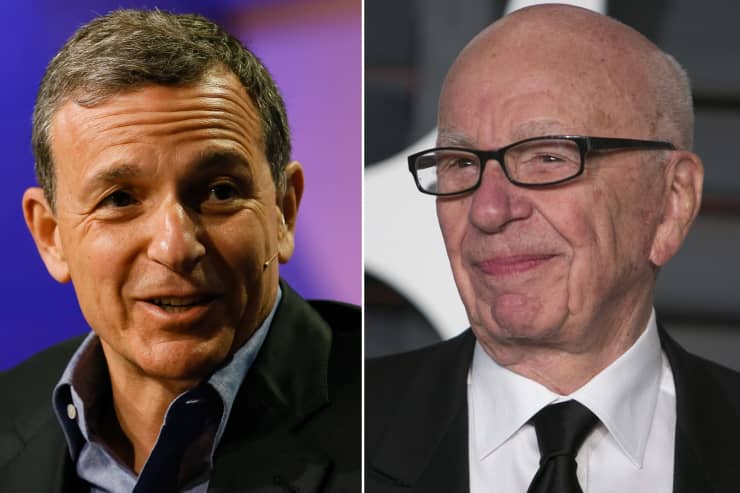
Premium: Bob Iger Rupert Murdoch split
Getty Images
Disney is a motivated seller because it can’t get its larger deal for Fox done without divesting the networks. The Department of Justice forced Disney, which owns ESPN, to sell the networks to alleviate concerns about too much sports programming power in the hands of one company. In fact, the networks might never even change hands, depending on when Disney’s larger deal of Fox closes.
Winning back the sports networks would be a coup for Rupert Murdoch, who could get the RSNs at a lower price than the value at which he sold them to Disney — a price that was driven up nearly $20 billion by Comcast’s rival bid for the bundle of Fox assets. There may also be beneficial tax benefits to Murdoch, related to tax-deductible amortization, one of the people said.
A declining asset that’s worth more to Fox than anyone else.
First, while the DOJ forced Disney to sell the RSNs to get the larger deal done, the networks were never a crown jewel asset for Fox, Disney or Comcast. Fox was willing to sell them (and did). Disney took them because it wanted other assets from Fox (its studio, its stake in Hulu, Star India).
Meanwhile, Comcast saw the RSNs as an albatross and was equally willing to divest them, according to people familiar with the companies’ thinking.
Regional sports networks used to be huge value-adds for the cable industry. They carry exclusive broadcasting rights to local games, which come with devoted fan bases. About a decade ago, the networks began to hike carriage fees, knowing cable providers would agree to the higher prices rather than risk alienating customers by blacking out the networks. That led to a steady rise in the cost of cable for consumers. Residents of markets like New York or Los Angeles, which have multiple teams and a handful of RSNs, were paying fees up to $10 a month (baked into their monthly cable bill) whether or not they were watching the games.
In recent years, pay-TV providers, which have seen millions of customers cut the cord, have started to see RSNs differently. Providers have pushed to tier them onto packages that appeal just to sports fans while keeping costs lower for everyone else. This has decreased the value of the networks, which are no longer automatically part of everyone’s basic cable packages.

Several pay-TV providers have dropped regional sports networks, refusing to pay their high programming fees. For instance, SportsNet LA, which broadcasts L.A. Dodgers games, which hasn’t been carried by DirecTV for five straight years.
If Fox ends up with the sports networks again, part of the reason will be that no other large pay-TV distributor -- Charter, AT&T, Comcast or Dish -- saw value in owning the networks. While Sinclair Broadcast Group CEO Chris Ripley has discussed making an offer for the networks with private equity support, it would need quite a bit of help. Sinclair’s market capitalization is just $2.8 billion. The regional sports networks were valued at more than $20 billion, according to a Guggenheim Securities analysis.
It’s still unclear how much New Fox is willing to spend on the networks — or what Disney values them at. What is clear is that Disney needs to sell them.
Disney to divest regional sports networks post-deal.
The second irony is Murdoch can once thank rival Comcast for making him money if he ends up with the networks.
When
Comcast and Disney were jockeying to buy Fox assets earlier this year,
one thing was never in doubt -- Murdoch wanted to sell to Disney.
Several times, Murdoch aligned himself with Disney’s bids against
Comcast.
Yet, the competitive Comcast bids let Murdoch net $19 billion more for his bundle of assets.
Now, Comcast’s participation could help him get the sports networks at a bargain.
Disney originally agreed to buy the Fox assets for $52 billion. Comcast’s rival bids for Fox pushed the price up to $71.3 billion. In that process, it pushed valuation of the RSNs higher, as it did for all of the assets (including 39 percent of British TV provider Sky, which Comcast later agreed to buy).
Disney almost certainly won’t find a buyer that will pay that inflated valuation for just the networks. New Fox’s most likely competitor (barring a competitive bid from a company like John Malone’s Liberty Media) is a private equity firm -- and there’s little chance a leveraged buyout firm could win a bidding war for the RSNs and satisfy its limited partners that it would make a future return on the assets.
(Disney, by the way, will end up getting $15 billion back for selling its 39 percent stake in Sky and possibly about $20 billion for the RSNs, making that $71.3 billion Fox deal look more like $36 billion.)
It’s possible Google, Amazon or another technology company would eventually be interested in the networks for the sports rights. But that seems unlikely. The regional sports networks are tied to a legacy cable system that tech companies typically view as anathema. If Amazon or Google wants regional sports rights, they can just wait until current contracts expire and bid on them then.
The final irony is Fox’s decision to sell the RSNs to Disney may have actually convinced Murdoch that it was better off keeping them. In the months following Fox’s decision to sell, New Fox has clarified its focus, centering itself around news and sports. Netflix publicly praised the company for that decision last week.
It’s possible Fox has come to the conclusion owning the RSNs makes more sense than selling them, even if it didn’t think so 10 months ago.
Disclosure: Comcast is the owner of NBCUniversal, parent company of CNBC and CNBC.com
Yet, the competitive Comcast bids let Murdoch net $19 billion more for his bundle of assets.
Now, Comcast’s participation could help him get the sports networks at a bargain.
Disney originally agreed to buy the Fox assets for $52 billion. Comcast’s rival bids for Fox pushed the price up to $71.3 billion. In that process, it pushed valuation of the RSNs higher, as it did for all of the assets (including 39 percent of British TV provider Sky, which Comcast later agreed to buy).
Disney almost certainly won’t find a buyer that will pay that inflated valuation for just the networks. New Fox’s most likely competitor (barring a competitive bid from a company like John Malone’s Liberty Media) is a private equity firm -- and there’s little chance a leveraged buyout firm could win a bidding war for the RSNs and satisfy its limited partners that it would make a future return on the assets.
(Disney, by the way, will end up getting $15 billion back for selling its 39 percent stake in Sky and possibly about $20 billion for the RSNs, making that $71.3 billion Fox deal look more like $36 billion.)
It’s possible Google, Amazon or another technology company would eventually be interested in the networks for the sports rights. But that seems unlikely. The regional sports networks are tied to a legacy cable system that tech companies typically view as anathema. If Amazon or Google wants regional sports rights, they can just wait until current contracts expire and bid on them then.
The final irony is Fox’s decision to sell the RSNs to Disney may have actually convinced Murdoch that it was better off keeping them. In the months following Fox’s decision to sell, New Fox has clarified its focus, centering itself around news and sports. Netflix publicly praised the company for that decision last week.
It’s possible Fox has come to the conclusion owning the RSNs makes more sense than selling them, even if it didn’t think so 10 months ago.
Disclosure: Comcast is the owner of NBCUniversal, parent company of CNBC and CNBC.com
15 Years Ago Today We Lost This Mega Star!

15
years ago today Johnny Cash left his home here on earth to join June in
their new home on the other side. I had the honor of meeting him and
his amazing family on several occasions. His concerts felt more like a
family jam session than the over produced flash and bang of today's
music events. His persona was overwhelming and yet you felt like part of
an extended family in his presence. I took this image at the end of his
concert. It was the last frame of film I had left on the roll. Long
live Johnny Cash!
https://www.facebook.com/JohnnyCashIsAlive/…
https://www.facebook.com/JohnnyCashIsAlive/…
Motivational Speaker TShane Johnson Pitch Video for the legendary Match Game!
Motivational Speaker TShane Johnson was asked to provide a pitch video for the legendary long running game show Match Game.
"We weren't really sure what the producers of Match Game expected so we just decided to have fun with it. I hope they enjoy it as much as we enjoyed putting it together."
~ Booyah Productions VP Ray Tharaldson

Match Game premiered on NBC in 1962 and was revived several times over the course of the next few decades. The game featured contestants trying to come up with answers to fill-in-the-blank questions, with the object being to match answers given by celebrity panelists.
The Match Game in its original version ran on NBC's daytime lineup from 1962 until 1969. The show returned with a significantly changed format in 1973 on CBS (also in daytime) and became a major success, with an expanded panel, larger cash payouts, and emphasis on humor.
The series was a production of Mark Goodson/Bill Todman Productions, along with its successor companies, and has been franchised around the world.
In 2013, TV Guide ranked the 1973–79 CBS version of Match Game as No. 4 on its list of the 60 greatest game shows ever.
Match Game returns to primetime!
Hosted by Golden Globe and Emmy Award-winning actor Alec Baldwin, the
iconic panel game show features four contestants who attempt to match
the answers of six celebrities in a weekly game of fill-in the missing
blank.

"We are excited to potentioanally spread our mission by being on this game show and have fun at the same time!" ~ TShane Johnson
We'll keep you posted as things develop, stay tuned!

"We are excited to potentioanally spread our mission by being on this game show and have fun at the same time!" ~ TShane Johnson
We'll keep you posted as things develop, stay tuned!
Hotel magnate, Gary Tharaldson, reveals his two biggest secrets to success

Gary Tharaldson shares
tales of his business career during a talk at Minnesota State
University Moorhead on Monday, April 16. Dave Olson/The Forum
MOORHEAD—Successful entrepreneur and hotel
magnate Gary Tharaldson shared stories from his business career during
an event at Minnesota State University Moorhead on Monday, April 16,
wowing his audience with tales of how a boy who grew up near Dazey,
N.D., on a farm that didn't have running water built a company that was
sold to its employees in 1999 for about $1 billion.
About 15
years later, those employees walked away with about $600 million when
they sold the company, providing many with a significant retirement
fund, according to Tharaldson.
He
said creating the employee stock ownership plan that made that possible
is one of his proudest accomplishments in a career that is still going
strong and is now chronicled in a book titled, "Open Secrets of Success:
the Gary Tharaldson Story," which is available on Amazon and was
written by Patrick J. McCloskey.
Tharaldson said the book
reflects his long-held practice of answering questions anytime people
ask him how he has gotten to where he is.
When it comes
to building hotels, Tharaldson's formula is simple: he teams only with
high-quality brands like Marriott and only builds in areas where
demographics almost guarantee success.
To help ensure
that, he said he determines who the major competitors are in a community
and then builds hotels with about 20 percent fewer rooms, which he says
usually results in higher occupancy rates and above-average profit
margins, usually around 40 percent.
"I stack the deck for
myself," Tharaldson said, adding that success comes in many forms and
for him it's not necessarily making lots of money.
"If you're truly doing what you love to do, then you're successful," he said.
Asked
what he feels are his three strongest talents, Tharaldson listed
attitude and a willingness to learn, as well as adopting a common sense
approach to most things.
When he struggled to come up with a third talent, his wife, Connie, supplied the rest:
"He never gives up," she said. "He finds a way to keep going and never, ever, gives up."
Tharaldson
told the audience, which was mainly MSUM students, that a major part of
what has made his hotels successful is the fact employees were given a
stake in whether the business succeeded or not.
"They acted like owners. They took pride in everything they did, knowing someday there would be a payday," Tharaldson said.
'Hate U Give' Actor Dropped From Movie After Racially Charged Remarks

Gabriel Olsen/WireImage Kian Lawley
Kian Lawley's role will be recast in the YA adaptation.
byAfter a video surfaced online of actor Kian Lawley making racially charged jokes, 20th Century Fox has decided to remove him from the upcoming release The Hate U Give.
“Due to the controversy surrounding his past comments and behavior, Kian Lawley will no longer appear in The Hate U Give. The studio plans to recast the role of Chris and reshoot scenes as needed," a studio rep said Monday in a statement.
The Hate U Give is based on the young adult novel by Angie Thomas. The story follows Starr, a young woman drawn to activism after she witnesses the police shooting of her unarmed friend. The story is inspired by the Black Lives Matter movement.
Hunger Games actress Amandla Stenberg leads a cast that also includes Regina Hall, Common, Issa Rae and Anthony Mackie. In the feature, Lawley was cast as Starr's white boyfriend.
"Words have power and can do damage. I own mine and I am sorry. I respect Fox’s decision to recast this role for The Hate U Give as it is an important story, and it would not be appropriate for me to be involved considering the actions of my past," said Lawley in a statement of his own. "I understand the impact and I have grown and learned since then. From now on I plan to use my voice for positive change."
While the film has not yet been given a release date, filming on Hate U Give wrapped in November. Fox's choice to recast Lawley so far into production parallels Sony's decision to replace Kevin Spacey with Christopher Plummer on Ridley Scott's All the Money in the World.
Lawley is best known as a YouTuber, but has tried to make the transition to acting, co-starring on the Fullscreen series H8TERS and appearing in AwesomenessTV features Before I Fall and Shovel Buddies.
Lawley is the latest social media star to land in hot water with creative partners after racial and culturally insensitive remarks were published online.
After Logan Paul posted a video on Dec. 31 that featured images of a suicide victim, YouTube put its original projects on hold with the actor and internet personality, including a sequel to the YouTube Red sci-fi thriller The Thinning. And Disney’s Maker Studios severed ties with YouTube gamer PewDiePie, aka Felix Kjellberg, after he released a series of anti-Semitic posts to his 53 million subscribers.
Justin Timberlake backed out of using Prince hologram at the last minute

Justin Timberlake during his Super Bowl performance
Getty Images (Composite)
Justin Timberlake was “100 percent ready to use the hologram” for his Prince tribute during his Super Bowl halftime show performance on Sunday, sources say — but backed out at the last minute.“He was 100 percent ready to use the hologram but nixed it due to backlash from social media and Prince fans. That’s why he had that sheet up like in your mama’s backyard,” sniped one insider.
Prince’s longtime pal Sheila E. had tweeted that Timberlake was not going to use a hologram after they spoke on Saturday. “Family, I spoke w/Justin 2nite and he shared heartfelt words of respect for Prince & the Purple fans . . . There is no hologram.”
But in an interview with “Entertainment Tonight,” she also hinted that she had nixed the hologram idea personally. “I just said no. I just felt that it was too soon,” she told ET. “The hologram was weird, and Prince did tell me [to] make sure nobody ever does a hologram [of him] . . . He thought it was very demonic and that’s his spiritual beliefs.”
However, a source close to Timberlake told us the hologram plan was never fixed: “There’s no way Justin would ever disrespect Prince’s legacy. He didn’t change his performance.”
Beckham's new MLS franchise glitz, glamour and growth potential

USA Today
by Paul TenorioMIAMI -- Before the confetti fell on David Beckham and his partners and before the throng of Miami fans cheered an announcement that was four years in the making, evidence of the glitz of a Major
League Soccer franchise in South Florida rolled on projection screens on the stage.
Celebrity endorsers from across every different entertainment field spoke into the camera to welcome MLS to Miami -- from actress Jennifer Lopez and New England Patriots quarterback Tom Brady to rapper Jay Z, Olympic gold medalist Usain Bolt and Paris Saint-Germain star Neymar.
If there was any doubt Miami was bringing a certain cachet to Major League Soccer, it ended when that reel was played for the audience of several hundred fans who had gathered downtown to welcome MLS back to the region.
That prestige is part, but not all, of what makes Miami such a perfect fit for MLS. And it's part of the reason why, for four years, the league and Beckham were so intent on making it work here, even when it seemed the team would never materialize.
The growth of MLS has come in part from the magnetism of major markets. There is a reason MLS has two teams in both Los Angeles and New York. To sell a player on tapping into the ever-profitable American audience, you need to sell the country's biggest cities: the Hollywood life on the West Coast and the "if you can make it here, you can make it anywhere" lore of the Big Apple.
Beckham's move to the LA Galaxy was the first major sign of how the right market can lure the biggest stars to MLS in the "modern" era. Those marquee markets have since brought the likes of Thierry Henry, David Villa and Giovani Dos Santos. Zlatan Ibrahimovic is rumored to be the next big name to head to L.A.
Now Beckham will launch a team in a city capable of bringing more big names to the league.
Beckham reminisced Monday about the move he made from Real Madrid to MLS. It was a massive gamble, but he was betting on a young league that had plenty of growth potential -- growth from which he could benefit, too. He recalled the challenge of coming to MLS and then held out his hands and cracked that famous smile.
"And, of course, L.A. wasn't the worst city to live [in]," he said.
Miami isn't so bad, either.
There is something about Miami that pulls in stars at almost the same rate they flock to Tinseltown. It's the beaches, maybe, or the style and glam of the city. There is an air of luxury and class and exclusivity. The Miami sunshine has seduced footballers such as Cristiano Ronaldo -- arguably the game's biggest star. It's partly why so many celebrities were ready to press record on those welcome videos.
"Most players love a city like Miami," said Marcelo Claure, CEO of Sprint and a member of the Miami expansion ownership group. "Miami is a hot place, a lot of people want to be here and a lot of people want to play for David Beckham's team."
It is among the reasons MLS remained so intent on launching a franchise in the market. But the leaders involved say it's not the only one.
As MLS has grown, so too has its outlook on what can grow the league. Yes, Beckham will open doors to top players. So, too, will South Beach. But the success of markets such as Atlanta have changed the perspective on the ingredients that can yield packed stadiums and on-field results.
It's not just about the megastar signing anymore. Miami also represents what MLS commissioner Don Garber called a "gateway" to a global market in which MLS is becoming a bigger player. It's as likely to attract the Miguel Almirons of the world as it is the Beckhams.
"This is such a rich city, with the culture and support for the game," Garber told ESPN. "International games get massive attendance, the World Cup [TV] ratings [are high], the MLS ratings, even without a team, are very high.
"It's [also] a gateway city for our entire country, it's a gateway to South America. So much of our success has been driven by players who have come from Argentina and Brazil and Paraguay and Venezuela and Uruguay, and our media coverage and fan support is really strong in South America.
So, if you could make it [work] here, it will open us up to such an important part of the footballing influence in our world."
David Beckham takes time for ESPN FC's Alexis Nunes to announce his plans for a MLS franchise in Miami.
The Miami businessmen have strong local ties that go back generations. Their involvement in the ownership group not only pushed the franchise over the line in the eyes of MLS, but also in the eyes of fans who are waiting to see just what this team is going to look like. The fans want the megastars, sure, but they also want a team that will represent Miami.
"The city has changed already in the 10 or 15 years since the [Miami] Fusion folded, and it's even more diverse, even more representative of what's happening in the country," said Andrew Bennett, 41, a Miami native and member of the Southern Legion, a Miami MLS supporters' group that has stayed alive while a team has teetered on the brink of existence for several years.
The Mas brothers "bring a level of credibility [to the franchise] it wouldn't have otherwise," said Bennett, whose neck was wrapped in a scarf stating "MLS to Miami."
The team is two years away from stepping on the field, but already its identity is starting to become clear.
Beckham mentioned Monday that he has already fielded calls from "top players" letting him know they're in. But his most verbose answers about the future of the club were about building an academy in Miami that would produce homegrown players.
It's a market that has the potential to do it all: to buy big, to develop its stars, to attract the South American markets and to capture a massive U.S. audience, too. It also has a unique ability to elevate the league from the moment it signs its first player.
And after years of waiting, the ownership group was ready to promises it won't sit on its hands and let the market for which it fought so hard go to waste.
"We have a lot of ambition to have a great, winning team," Claure said. "None of us do this to be second. Look at the roster of owners we have; we are going to do whatever it takes to build academies [and] recruit great players. This is going to be a great team, of that I can assure you."
Ray Tharaldson: Great Norwegian Movies Everyone Should See
Ray Tharaldson: Great Norwegian Movies Everyone Should See: by Marcus Clark Norway has often been overshadowed by its Scandinavian neighbours Denmark and Sweden on the European art-house scene....
Ray Tharaldson: Skam: the Norwegian hit that could take US TV into...
Ray Tharaldson: Skam: the Norwegian hit that could take US TV into...: To be renamed Shame in the US, this gritty high school drama has developed an intense following for its frank and realistically flawed ...
How Overseas Film Sales Are Saving Hollywood!

That’s because as badly as so many franchise films and reboots have done in the world’s biggest cinema market, they’ve racked up solid ticket sales elsewhere. Theater-goers in America thought Paramount Pictures’ fifth “Transformers” was pretty much a yawner, but in China they liked it. And No. 6 is already in the works.
“Look at the casualties just this summer,” said Paul Dergarabedian, a Los Angeles-based analyst for ComScore Inc. “If they only had North America, it would be a monumental disaster for the studios.”
For now at least, the rest of the world -- China in particular -- is supporting Hollywood’s love affair with series, sequels and rehashes like “The Mummy,” Universal Pictures’ new take on a story that’s been told dozens of times. The risk is that sequel fatigue will set in overseas too. Chinese moviegoers are becoming more choosy, and the fastest-growing film market is slowing down. That’s a challenge for studios such as Walt Disney Co. and Time Warner Inc.’s Warner Bros., which plan and schedule movies years in advance.
Jonathan Papish, an analyst for China Film Insider, described as a “disaster” the $250 million that “Transformers: The Last Knight” is projected to record in the world’s most-populous country. The reason: the previous version from Viacom Inc.’s film division pulled in 17 percent more, “a worrisome sign for both Paramount and other Hollywood studios who have become far too complacent thinking that Chinese audiences will swallow whatever garbage they shove down their throats.”

Not every sequel or franchise entry has fallen flat in North America, of course. “Wonder Woman,” Warner Bros.’ fourth episode in the DC Extended Universe series, has taken in $346 million domestically and is one of the year’s top films. Disney’s “Guardians of the Galaxy Vol. 2” topped the box office for two weeks and has taken in $383 million domestically.
And there are some big-hitters coming. Sony Corp.’s “Spider-Man: Homecoming” is expected to take in $301 million in North America after its release this weekend, according to BoxOfficePro.com.
“War for Planet of the Apes,” out July 14 from 21st Century Fox Inc., could grab $165 million.
But the second-quarter domestic box office ended down 3.6 percent from a year ago at $2.7 billion, Barton Crockett, an analyst at FBR & Co., said in a note. He blamed disappointing sequels; even with a better-than-expected “Wonder Woman,” he predicts a 15 percent decline for the third quarter.
Chinese box-office sales fell in June, as local movies as well as Hollywood imports failed to meet expectations. This month, PricewaterhouseCoopers LLC pushed back its forecast for China’s movie market to overtake the U.S. to 2021 from 2017.
This weekend, Universal’s “Despicable Me 3” will test the Chinese market, after opening in first place in 44 out of 46 countries, according to data from the film division of Comcast Corp. A new installment in another Universal series, “The Fate of the Furious,” enjoyed strong demand in China, taking in $393 million there earlier this year.
Even with big budget films flopping at home, movies can earn money for years to come from digital downloads and sales to Netflix Inc. and other streaming sites and cable-television channels. The latest -- and last -- “Pirates of the Caribbean” may have missed expectations when it came out May 26, but it could end up generating a net profit of $219 million, according to an estimate from Wade Holden, analyst with S&P Global Market Intelligence.
That hasn’t stopped some analysts from complaining that studios have focused too much on making big-budget features.
“There is an over reliance on sequels,” said Richard Greenfield, a media and technology analyst at BTIG LLC. The major studios “are so worried about investing in an unknown property that they are all just relying on sequels and hoping that sequels will save them.”
While Disney has had tremendous success, Greenfield said it’s not bullet-proof. “The danger is that investors are essentially assuming that a movie like ‘Star Wars’ will be successful forever.”
As much as any studio, Disney has tied its future to sequels and remakes. The company’s 2017 schedule includes eight films, of which six fit that profile, according to Box Office Mojo.
Disney said its strategy sets it apart from the competition -- in 2016 its film business had its most profitable year ever. Other studios trying to ape it have had less success. Sony, for example, tried and failed to refresh its 1984 hit “Ghostbusters” last year in the hope that it could spawn a new series.
In any event, many future slates are laden with new installments of existing worlds of characters. 21st Century Fox and Sony, which license Marvel characters, are planning more “X-Men” and “Spider-Man” chapters.
Disney has laid out several years worth of Marvel superhero offerings and at least a six-picture series of “Star Wars” movies. Meanwhile, the company is revisiting “Mary Poppins” and “Mulan.”
“Studios are rushing these sequels,” said Jeff Bock, senior analyst at Exhibitor Relations Co. “If you want to get the domestic audience back, you’ve got to do something a little outside the box.”
Subscribe to:
Posts (Atom)